Lenin participates in affiliate programs. Using links helps fund archiving and scanning work.
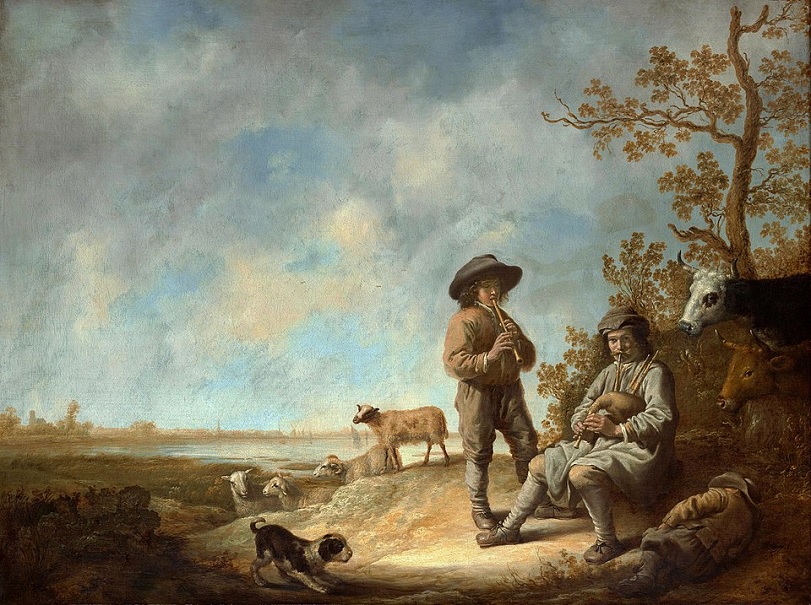
Aelbert Cuyp was one of the great Dutch landscape painters of the 17th century, admired today for the luminous serenity of his Arcadian river scenes. Born and later buried in Dordrecht, he came from an artistic family: his father, Jacob Gerritsz. Cuyp, was a well-known portraitist, and Aelbert’s earliest landscapes—such as the Landscape with Cattle (1639, Musée des Beaux-Arts, Besançon)—show traces of his father’s influence. In his youthful work he also experimented with the tonal style of Jan van Goyen, adopting soft greys, browns, and silvery light to evoke the quiet atmosphere of the Dutch countryside.
By the early 1640s Cuyp’s style shifted as he encountered painters like Jan Both, whose Italian travels introduced golden light, warm colour, and classical harmony into Dutch landscape painting. Cuyp absorbed these ideas fully, transforming his work into the radiant landscapes for which he is now celebrated. His scenes are often bathed in a soft glowing haze, with warm light settling gently over water, hills, cattle, and distant horizons. The effect is peaceful, balanced, and timeless—qualities that later made him particularly beloved by English collectors.
Cuyp excelled especially in river views and pastoral scenes. His compositions often feel calm and meditative, their stillness strengthened by his tendency to generalize specific locations. The View of Nijmegen (Indianapolis Museum of Art) shows this atmospheric approach, where exact topography becomes secondary to mood. At times he chose a very low viewpoint—such as in Herdsman and Five Cows by a River (National Gallery, London)—to create a monumental sense of space and to give ordinary cattle a heroic presence. Cuyp rarely attempted narrative or dramatic subjects, and when he did, as in Christ Entering Jerusalem (Glasgow Art Gallery and Museum), the results were noticeably less successful.
One of his most evocative works, The Maas at Dordrecht (Kenwood, The Iveagh Bequest, London), is among several paintings depicting the mouth of the river in his native town. Although there is no firm documentary proof that Cuyp travelled extensively, his paintings and drawings suggest he visited Utrecht and followed the Rhine on sketching trips. His marriage in 1658 brought him into the prosperous merchant class of Dordrecht, and he later purchased a country estate—prosperity that likely reduced his dependence on painting. Because he dated so few works, establishing a precise chronology is challenging, but evidence suggests his output diminished significantly in his final years.
Cuyp had relatively little direct influence on artists outside Dordrecht, yet his reputation grew immensely in the centuries after his death. English collectors in the 18th and 19th centuries in particular developed a passion for his glowing landscapes, acquiring many of his finest works. Thanks to them, some of the most radiant and important Cuyp paintings remain in England today, where his legacy continues to shine.
Lenin participates in affiliate programs. Using links helps fund archiving and scanning work.