Trivia
S N I P P E T S
All images
© M.C. Escher Foundation and The M.C. Escher Company. Direct links to 1 of the best Escher books on the market. Available @ ebay.co.uk and a direct link to it below.

Random Facts
M.C. Escher
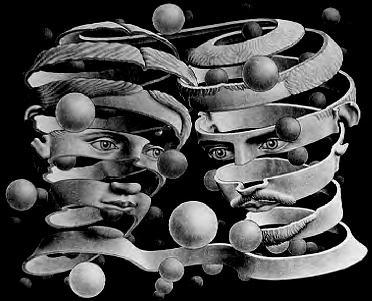
Bond of Union
© M.C. Escher Foundation and The M.C. Escher Company
MAURITUS CORNELIS ESCHER (Artist)
Born: 17 June 1898
Birthplace: Leeuwarden, Netherlands
Died: 27 March 1972
Best Known As: Mind-bending artist of "Hand With Reflecting Sphere"
Trivia:
Most of the info sourced below is from the informative and always well priced, The Life and Works of Escher. Plus there are quite a few stunning reproductions. Direct link here to the book @ ebay.co.uk.
Giotto was the first artist to demonstrate the practice of foreshortening in the 14th century. Escher took it even further, creating the illusion of depth on a flat surface that no one has come close to replicating. The ultimate achemist.
He was the youngest son of a Dutch engineer.
He attended the School of Architecture and Ornamental Design in Haarlem 1919-22.
Switching to graphic design, he was trained under Jessurun de Mesquita, a master printmaker.
He made his first lithograph in 1920-21.
Escher made his first wood-engraving in 1926.
He himself belittled the prints he produced before 1935.
He lived in Italy between 1923 and 1935.
Much of his inspiration came direct from nature.
Escher, his wife Jetta and their three children, left Rome for Switzerland in 1935.
They moved to Brussels in 1938.
They set up permanent home in Holland in 1941.
He became internationally successful in the 1950s. He had exhibitions in Washington D.c., Italy and Holland. During this time his work was published in Time and Life.
He was knighted in 1955.
On the day he was born, the United States Navy Hospital Corps was established.
On the day he died a famous Dutch footballer, Jimmy Floyd Hasselbaink, was born in Paramaribo, Surinam.
M.C. Escher: Key works, in date order, are as follows and details of each print. Low quality scans - to see really beaufiful reproductions then get the book The Life and Works of Escher. Direct link here to the book @ ebay.co.uk. Nothing on the internet comes close to seeing a Escher in real life or, failing that, obtaining a book with top quality reproductions. Moreover it supports the book in question - encourages publishers to publish more and supports the author. The book in question is hardly expensive so if you can support the book before it becomes extinct or as dead as the Dodo. Make a difference in the world - buy something that means something to someone else. Don't just walk on by.
Portrait of Jetta (Low Resolution Photo, Detail), 1925
Woodcut
Jetta Umiker captured Escher's heart when he met her in Ravello in 1925. She was the daughter of a German-Swiss industrialist and she and her family were passing the winter in Italy. They married in Viareggio in April, 1924, much against the wishes of Jetta's father, who was not enthusiastic about his daughter entering the
Catholic church, which she did later in the same year...More from the book, The Life and Works of Escher. Direct link here to the book @ ebay.co.uk.
© M.C. Escher Foundation and The M.C. Escher Company/Parragon
Tower of Babel (Low Resolution Photo, Detail), 1928
Woodcut
This is a pivotal work in Escher's early development, the unusually high viewpoint creating a vertiginous aerial perspective, a choice made not simply for aesthetic ends...More from the book, The Life and Works of Escher. Direct link here to the book @ ebay.co.uk.
© M.C. Escher Foundation and The M.C. Escher Company/Parragon
Scarabs (Low Resolution Photo, Detail), 1935
Wood engraving
t times, Escher's illustrations were close to being botanical. In Scarabs, he returns to a subject which had caught his attention a decade erlier, while living in Siena...More from the book, The Life and Works of Escher. Direct link here to the book @ ebay.co.uk.
© M.C. Escher Foundation and The M.C. Escher Company/Parragon
Portrait of G A Escher (Low Resolution Photo, Detail), 1935
Lithograph
A drawing made by Escher of his father in 1916 acted as a reference for this later lithograph. The artist's fascination with the minutiae of life, of detail and perspective, were perhaps traits which he had learned from a father with similar interests. He had returned to Holland to visit his parents in July 1935 and produced the lithogaph while in his father's company...More from the book, The Life and Works of Escher. Direct link here to the book @ ebay.co.uk.
© M.C. Escher Foundation and The M.C. Escher Company/Parragon
Porthole (Low Resolution Photo, Detail), 1937
Woodcut printed from two blocks
The image of one ship viewed through the porthole of another follows two of Escher's principal themes - the union of different worlds and dual perspective within one image. Escher uses the subject to experiment with mathematical ideas. The woodcut was produced from two pieces of reference - a drawing and a photograph...More from the book, The Life and Works of Escher. Direct link here to the book @ ebay.co.uk.
© M.C. Escher Foundation and The M.C. Escher Company/Parragon
Still Life with a Street (Low Resolution Photo, Detail), 1937
Woodcut
During the couple's travels, tney visited the Spanish harbour town of Savona. While there, 'I discovered a picturesque old street between high houses which I drew from the first floor of a shop.' This woodcut invited the life of the street to enter the stillness of the shop interior...More from the book, The Life and Works of Escher. Direct link here to the book @ ebay.co.uk.
© M.C. Escher Foundation and The M.C. Escher Company/Parragon
Development I (Low Resolution Photo, Detail), 1937
Woodcut
In August 1937 the Eschers moved to Brussels. As the year wore on, so Escher's interest in the regular divisions of the plane developed. Escher had visited his brother, a professor of crystallography, from whom he learned the term and the three theories inherent to the development of symmetry on a flat surface...More from the book, The Life and Works of Escher. Direct link here to the book @ ebay.co.uk.
© M.C. Escher Foundation and The M.C. Escher Company/Parragon
Portrait of Jetta (Low Resolution Photo, Detail), 1938
Lithograph
The metamorphosis which takes place in this image goes through many complex stages than in any earlier experiments with the regular division of plane. From building blocks made of three simple diamond shapes, filled in black, grey and white to suggest solid form, a pattern evolves in which the shapes slowly come to life as comic figures running from the house...More from the book, The Life and Works of Escher. Direct link here to the book @ ebay.co.uk.
© M.C. Escher Foundation and The M.C. Escher Company/Parragon
Sky and Water 1 (Low Resolution Photo, Detail), 1938
Woodcut
Using grades of black and white, Escher chose birds and fish to divide up a flat surface. The two shapes interlock and perform dual purposes - they are birds and fish, but become sky and sea for one another to fly and swin in...More from the book, The Life and Works of Escher. Direct link here to the book @ ebay.co.uk.
© M.C. Escher Foundation and The M.C. Escher Company/Parragon
Day and Night (Low Resolution Photo, Detail), 1938
Woodcut printed from two blocks
Day and Night is Escher's first full-scale transformation print. The rectangular shapes transform into three-dimensional objects. The fields become black and white birds which appear to exist on a new plane, flying above the patchwork of fields in the sky...More from the book, The Life and Works of Escher. Direct link here to the book @ ebay.co.uk.
© M.C. Escher Foundation and The M.C. Escher Company/Parragon
Verbum (Low Resolution Photo, Detail), 1942
Lithograph
Escher chose the title Verbum for its association with the story of the creation. No one element within the composition dominates. Escher wanted to encourage the eye to move undirected from the centre of the image which one is accustomed to perceiving as its heart...More from the book, The Life and Works of Escher. Direct link here to the book @ ebay.co.uk.
© M.C. Escher Foundation and The M.C. Escher Company/Parragon
Reptiles (Low Resolution Photo, Detail), 1943
Lithograph
Reptiles is one of Escher's most celebrated images: expounding his theories clearly while providing a great source of entertainment for the viewer. A drawing of reptiles, successfully interlocking to fill the two-dimensional plane, is disrupted by the apparent 'escape' of one of its number, in the bottom left-hand corner of the sketchpad...More from the book, The Life and Works of Escher. Direct link here to the book @ ebay.co.uk.
© M.C. Escher Foundation and The M.C. Escher Company/Parragon
Encounter (Low Resolution Photo, Detail), 1944
Lithograph
In this strange, possibly subterranean world, the black and white figures begin as imprints or shadows upon a wall. But then they take on more solid forms and begin to move and dance around a circle on a flat floor surface...More from the book, The Life and Works of Escher. Direct link here to the book @ ebay.co.uk.
© M.C. Escher Foundation and The M.C. Escher Company/Parragon
Direct links to 1 of the best Escher books on the market. Available @ ebay.co.uk and a direct link to it below.
Escher Books
Escher Dvds @ amazon.com (direct link)
Escher Books @ amazon.com (direct link)
M.C. Escher
Trivia
Books
Key Works
Desktop Page
Advertise This Page
Search Site
Top of Page
© Lenin Imports