Mutiny on the Bounty
1 9 6 2
ac·tor/'akt-r/
{Noun} 1. A person whose profession is acting on the stage, in movies, or on television.
2. A person who behaves in a way that is not genuine.
"If Mr Brando would care to tell me beforehand what he'splanning to say, then I might know when he's going to finish!."
- Trevor Howard on location durinng the filming ofMutiny on the Bounty (1962)
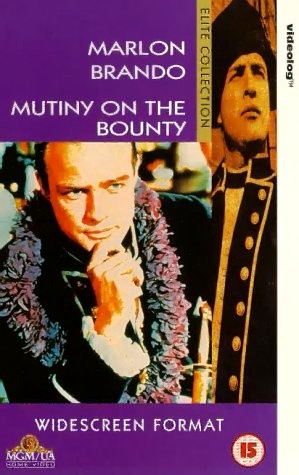
Mutiny on the Bounty: Video On Demand: Rent or Buy
------------
CREDITS
• US • Colour • 177mins •
cast - Marlon Brando Fletcher Christian
- Trevor Howard Captain William Bligh
- Richard Harris John Mills
- Hugh Griffith Alexander Smith
- Richard Haydn William Brown
- Tarita Maimiti
- Tim Seely Edward Young
- Percy Herbert Matthew Quintal
- Gordon Jackson Edward Birkett
- Noel Purcell William McCoy
- Duncan Lamont John Williams
- Chips Rafferty Michael Byrne
- Ashley Cowan Samuel Mack
- Eddie Byrne John Fryer
- Keith McConnell James Morrison
- Frank Silvera Minarii
- Ben Wright (1) Graves
- Henry Daniell Court martial judge
- Torin Thatcher Staines
- Matahiarii Tama Chief Hitihiti
crew- Dir:
- Prod:
- Scr:
Charles Lederer, Eric Ambler, William L Driscoll, John Gay, Ben Hecht, Borden Chase, from a novel by Charles Nordhoff, James Norman Hall
- Ph:
- Ed:
- Mus:
- Art Dir:
George W. Davis, J. McMillan Johnson
(M-G-M/Arcola)
------------
Extract below from the brilliant book:
Trevor Howard : A Personal Biography
KINDLE EDITION
Book Available: amazon.co.uk
------------
REVIEW
(Cont.):
BETWEEN The Men (1950) and The Godfather (1972) Marlon Brando was arguably the brightest and most original star in movies. Heput method acting on the map and gave it respectability. Trevor Howard's involvement with Brando began one day when the director Carol Reed telephoned him to ask if playing Captain Bligh in a remake of Mutinyon the Bounty appealed to him and what changes he would make toCharles Laughton's 1935 portrayal.
Howard, who knew Laughton well, thought that Hollywood hadruined the story of the mutiny by trying to depict the conflict between Bligh and Fletcher Christian, the mutineers' leader, as a simple black-and-white struggle between good and evil. Bligh had been less evilthan portrayed by Laughton, and the real-life Christian, played byClark Gable, had been no saint.
Howard felt that there was sufficient meat in the true story to makefictionalization unnecessary. It could be dramatized for the screenwithout jettisoning the facts. Although he and Reed had no previousdiscussion of the subject, their views were similar. Howard thoughtnothing more about the conversation until Reed phoned him twomonths later with the news that the green light had been given, thatMetro-Goldwyn-Mayer would produce it and that the role of CaptainBligh was his. Howard was told that he was everyone's first choice forthe role, including Brando's, who would play Christian. Howard accepted immediately, elated at the thought of working again with Reed and for the first time with Brando. What he did not know at thetime was that, in order to attract the moody star, MGM had caved into several of Brando's demands which would stretch relationshipsbeyond breaking-point and send the production costs spiralling.
Desperate to repeat the success of its remake of Ben Hur (1959), which scooped up eight Oscars, the studio decided to film the exteriors in Tahiti where the Bounty collected its cargo and where the sunand the sand and the tropical vegetation would provide an authenticbackdrop. The cast and crew thus assembled on Tahiti in readiness forthe arrival of a full-size replica of the Bounty, built in Lunenburg, NovaScotia, at a cost of $700,000. Work began on the three-masted ship inFebruary 1960. It was as faithful a replica of the original as circumstances would allow, although additional space was needed for securingand moving the cameras during filming. The total height from thedeck to the top of the mainmast was 103 feet. More than 10,000 squarefeet of canvas was used for the sails. Severe weather delayed the delivery of large quantities of oak from New Jersey which were needed forthe planking.
Careful planning failed to avert costly delays and disappointments.From the beginning, one disaster followed another. The design modifications and extra weight (of a diesel engine, camera mounts and soon) seriously affected the buoyancy and steerability of the ship, whichmeant that it not only took longer than planned to reach the SouthSeas from Nova Scotia via the Panama Canal but that it almost capsizedseveral times and caught fire twice during the 7,327-mile voyage. Itfinally reached Tahiti on 4 December 1960, two months after the film'splanned starting date.
Tahiti is the largest of a group of islands known as the Society Islandgroup, which include Moorea and Bora Bora. Scenes were filmed onall three islands. The total population of Tahiti is around fifty thousand, more than half of whom live in the only town of any size on the island, Papeete, which became headquarters for the unit. The interiorof the island is rugged and beautiful, with lots of crags and peaks, palmtrees and plunging waterfalls, but hardly any inhabitants. The bulk ofthe population hugs the coastline.
The first scene that Reed filmed was the stone fishing sequence, inwhich hundreds of native women wade offshore and, beating the waterwith their hands, drive the fish towards their menfolk in canoes. Almostevery inhabitant of the island appeared in the shot, each of whom waspaid $10 a day. The eight hundred who used their canoes to catch the fish earned a further $ 10, and they were allowed to keep whatever they caught. The scene depicting the arrival of the Bounty at Matavaii Bay was filmed with more than six thousand Tahitians milling around onthe sea and on the shoreline. These scenes were not only spectacular to watch; they recreated the original event with uncanny accuracy.
The true story of the Bounty is well documented. It set sail fromSpithead in England on 23 December 1787 under orders to proceedto Otaheite (later renamed Tahiti) to collect breadfruit for transportto the West Indies. Early explorers such as Captain Cook had reportedthat breadfruit, the staple diet of the South Seas, produced strong,healthy islanders. Colonists in the British West Indies wanted an inexpensive, nourishing food for their African slaves, and they petitionedthe King, George III, to have it introduced to the colonies. The Bounty,under Captain Bligh, was commissioned to transport a cargo of youngbreadfruit samples to Jamaica, where they were to be replanted, grownto full size and harvested.
While passing through Endeavour Strait, off the island of Torfua, en route for Jamaica, the mutiny erupted. Its leader was FletcherChristian. The trigger was Bligh's curtailment of drinking water forhis crew, because the plants needed more of it than he had allowedfor. There was only so much to share around, and if the choice wasbetween saving the men or the cargo Bligh was under orders to safeguard the breadfruit first and foremost. Every drop of water had tobe rationed. Not surprisingly, the crew mutinied and seized controlof the ship.
Bligh and eighteen crew members who remained loyal to him wereset adrift in an open boat no more than twenty-three feet long. Theywere expected not to survive. But forty-one days later, against overwhelming odds, they waded ashore at Timor in the Dutch East Indies,having rowed a distance of 3,618 miles with the loss of only one life.And that man had not been lost at sea. He had been killed by hostilenatives on a small island after the boat had pulled up on the beach foran overnight rest.
In an effort to keep their whereabouts secret from the Admiralty, Christian and his followers left Tahiti and sailed 1,300 miles southwards to the uninhabited island of Pitcairn, which is only two mileslong and a mile wide. They burned the Bounty so that it could not beseen from a passing ship. The island became their home, and alsotheir prison, since they had destroyed their only means of getting awayfrom the island.
It was a story that lent itself to numerous interpretations. Brando disagreed with the slant British screenwriter Eric Ambler had put onthe story. He wanted something 'more meaningful'. Ambler endured the star's moody criticisms for several weeks and then quit. Withreplacement writers the same arguments persisted, and while this wasgoing on filming ground to a halt. Papeete became a transit camp forthe hundred-strong disgruntled unit, although it was generally feltthat being paid regularly for taking life easy was nothing to grumble about.
Reed was wary of upsetting Brando unnecessarily, but he wantedthe story told truthfully, and what emerged from Brando's daily tinkering with the script was a storyline that departed from the truth atseveral critical points. Reed was also annoyed at the ease with which Brando subverted the procession of screenwriters who displaced eachother with clockwork precision. Charles Lederer, for example, incorporated all Brando's impromptu mutterings into the script, whetheror not they made narrative sense. Mostly they did not. Between themthey turned Bligh into a one-dimensional bad guy, a scowling ogrebetter suited to a B-movie. The real-life Bligh was bull-headed andhad a notorious bad temper, but he was not a sadistic megalomaniac,and the sailors under his command, while treated harshly, suffered noworse than others in naval service during the eighteenth century. When Reed pointed this out Brando went into one of his prolonged sulks,and the atmosphere between them which had begun so promisingly took an abrupt nose-dive.
Howard and Richard Harris, who was playing a character called John Mills, promptly took Reed's side, and, gradually, a split emerged.It was not serious to begin with, but, as views became entrenched andprofessional pride entered the equation, the divisions widened. Onefaction comprised Brando, Lederer, the producer Aaron Rosenberg,a front office executive called J.J. Cohn and the cinematographer BobSurtees. The rival group that formed behind Reed included most ofthe British and Irish actors on the film. Howard promptly emerged astheir most articulate and respected spokesperson. He also had themost to lose among the British and Irish contingent if the film turnedout to be a flop.
While genuinely in awe of Brando's talent, this group were puzzledby his wilful conduct. He had hijacked the production and appearedaccountable to nobody. With a growing sense of helplessness Reed'ssupporters retreated to their favourite bar in Papeete, Quinn's, andbriefly contemplated a mutiny of their own.
Then, suddenly, a new problem swept in from the sea: heavy rain.Solid, unrelenting rain. In MGM's eagerness to get started, nobodyhad considered how bad the weather can be in the South Seas at theend of the year. Cloudbursts forced everyone to dash for cover, strongwinds put the small boats out of action and, at times, almost toppledthe replica of the Bounty where it rested, top-heavy, in shallow water.Illness was another delaying factor. One by one key members of theunit collapsed with dysentery and other debilitating tropical conditions. Finally, demoralized after four months of relative inactivity, andwith the bills mounting at the rate of $50,000 a day, the studio wasforced to switch production to Hollywood where the sound stages wereequipped and waiting.
Back in Hollywood Brando and Reed continued their disagreements. Rumours that a vast amount of money had been squanderedwith barely anything to show for it caused shares in MGM to plungeseveral points. Panic and gloom engulfed Culver City. The pressstopped believing it would be 'Ben Hur Part Two' and began callingit 'Cleopatra on Water'. Brando, of course, could not be sacked, but Reed had no safety-net. Before the director had unpacked his suitcasethe knives were out for him.
The head of production, Sol Siegel, accused Reed of mishandlingthe Tahitian shoot and insisted that every effort be made to catch upwith the original schedule. The director agreed but could not give Siegel a completion date. Siegel lost his temper at Reed's refusal toprovide the answers he wanted to hear. 'You have a hundred days tofinish the job,' said Siegel flatly.Reed shook his head. 'I won't say "yes" because I know I can't do itin that time,' he said. 'One hundred and fifty days, maybe.'
This statement fell on deafer ears than Reed's earlier plea to keepthe story factual - a request that had Siegel on his feet shouting,'Nobody goes to the movies to watch history! We have museums forthat!' Siegel and MGM's vice-president Ray Klune decided that theonly solution was to cut their losses, and, reluctantly, they told Reed that his services were no longer required. Honesty, bad weather and astar actor who would not behave had cost Reed his job.
Howard and Richard Harris were angry when they heard the news. Harris groaned, 'We're in the hands of bloody philistines.' They wanted Siegel to reconsider.
By then Siegel was sick of all of them. He told them: 'Gentlemen,before you say anything, I want you to understand one thing. A star isa star. Everyone else is expendable. Reed doesn't want the job, and Idon't want him doing the job. Now what was it you wanted?'
Howard later recalled, 'Carol's departure, for reasons that I quite understand, was a terrible shock. Without him, they made a different film.'Earlier he had told Cecil Wilson of the Daily Mail: 'When Carol offeredme the part, the idea was that we should bring out the good side ofBligh as well as the bad. We had talked this over. But the Americansthought that the public wouldn't be interested. Theywanted as big a villain as Charles Laughton had been in the old picture.It's wrong to show a real person like Bligh in a false light.'
But thestudio was not interested in historical accuracy. It was desperate for abox-office smash hit. It really did seem to think it was making 'BenHur Part Two'. It was the same basic formula. Swap the chariots for agalleon and roll the cameras.
Reed's replacement was Lewis Milestone, a veteran director whohad made the granddaddy of all anti-war movies, All Quiet on the WesternFront (1930). Brando nodded through his appointment, because bythen it scarcely mattered to him who picked up the reins after Reed.He would film it the way that he wanted, and a director nearing seventywith the same recent track record as Greta Garbo - in that he hadn'tmade a film for thirty years - suited his plan perfectly.
After several weeks in Hollywood, filming the departure of the Bounty from Spithead at the start of the voyage, Bligh recounting hismisfortunes to the Admiralty and the subsequent court martial of thecaptured mutineers (which was cut in the final edit because Brando wanted the film to end with Christian's death), the unit returned toTahiti on 22 April 1961 to restart location work in improved, althoughless than ideal weather conditions. Filming the mutiny on board the Bounty, when Christian and Bligh have their violent confrontation,took most of the month of June. Half of the cast and crew becameseasick as the ship was battered by strong offshore winds. Howard later said that every evening, after he had returned to dry land, he continued to feel the ground heaving beneath his feet. 'And that was beforeI'd had a f##king drink!' he joked.
Lewis Milestone was on a completely different wavelength to Brando. While Carol Reed had been receptive to the star's constantrevisions to the script, Milestone wanted none of it. He had no patiencewith method actors. He distrusted their preoccupation with meaningand motivation. The only meaning that an actor needed was in thescript. Milestone expected them to learn it, perform it and not askquestions about it. But Brando was too sharp for him. Within days hehad circumvented the veteran director and was giving the orders. Milestone battled on for a while, growing more and more exasperated,but the writing was on the wall or, in this case, on a fresh batch of scriptpages which Brando distributed each morning. Before long Milestone was pointedly omitted from the circulation list. Nobody was sure why Brando decided to play Christian as a laughable fop; but nobody hadthe authority to stop him.
Brando's bizarre performance did not go down well with Harris.In the scene in which Christian slaps Mills, the sailor played by Harris,to show his opposition to the idea of a mutiny, Brando merely brushed Harris's face with the back of his hand. It was an effete, almost girlishslap. Harris responded with a mock curtsy and waggled a limp wristin the air. Everybody saw the joke except Brando. They tried the sceneonce more, and again Brando's blow was almost non-existent.Everybody waited to see how Harris would react. He did not fail them.He thrust his chin forward and said, 'Come on, big boy. Why don't youf##king kiss me and be done with it!' Brando stared at him, white withrage. The Irishman decided that he had had enough. He turned hisback on Brando and marched off the set.
The next day they returned to the scene, but despite furtherbarracking from Harris Brando would not change the way that helanded the blow. When the shot was completed to his satisfaction hecalmly walked off the set. Harris had to be restrained from going afterhim. According to Peter Manso, Harris told an American reporterthat when he returned, three days later, Brando approached him andsaid: 'Dick, you shouldn't have done that. I'd like you to know this.I'm the star of this picture and you're opposing me. Remember that,please.'
Brando's insistence on multiple takes was a further irritation forthe British actors, who were used to working much faster. In anotherscene with Harris, after a dozen or more takes Brando appearedsuddenly to lose interest and walked away muttering, 'I don't know ifit's going to work or not.' Harris was left standing with his mouth open,without any hint of an acknowledgement from Brando. The angerboiled up inside him again. 'Damn you! Look at me! Act! Who the helldo you think you are?' he shouted at the retreating star.
Howard, less truculent than Harris but equally disenchanted, griped about his co-star's demands to rewrite everything just beforea take. The rewriting, of course, was intended for everyone except Brando, who never took the trouble to learn lines because it drainedenergies which he preferred to disperse off the set. He had wordschalked on large boards from which he read whenever he felt likeit and ignored at other times. A dispassionate observer woulddeduce that Brando saw other actors' lines as merely convenientspaces for him to think up what he would say or do next. Howard complained, 'You never know where the hell you are. You don't knowfor ten minutes what you're playing because the next scene contradicts it.'
After one disagreement with him, Howard began to call him 'MrBrando', partly to mock the fact that Brando had taken charge but alsobecause of the continuous references made throughout the script to'Mr Christian'. When Milestone tackled Howard for being slow torespond to Brando's lines, Howard's impatient roar echoed aroundthe set. Milestone said: 'Trevor, I'm just trying to get to the root of theproblem.' Howard pointed a baleful finger at Brando. 'There's yourf##king problem,' he roared. 'If Mr Brando would care to tell mebeforehand what he's planning to say, then I might know when he'sgoing to finish!'
Most of the time, though, he managed to keep a lid on his frustration. Sometimes he paid Brando back in his own currency. Onestiflingly hot day a scene had been set up on the shoreline at Bora Borashowing the natives' welcome for the sailors off the Bounty. It was amassive scene, with thousands of extras spread around the beach andwaiting in the shallow water. Howard took his place in the bakingsunshine, clad in a heavy ceremonial uniform and hat. Brando couldbe seen twenty or so yards along the beach, shaded by a palm tree,chatting with three Polynesian girls.
Ridgeway ('Reggie') Callow, the assistant director, called everyoneto order through a loud-hailer. Brando made no movement. Hecontinued to talk to his lady friends. Once more Callow called out, 'MrBrando, we're ready for you.' The amplified voice carried easily towhere Brando stood, but again he pretended not to hear. Howard,meanwhile, continued to sweat under a hat which grew hotter by theminute. A further call to Brando got no response. Had there beenwater in Howard's headgear by this time he could have brewed himselfa coffee. At the fourth invitation Brando broke off his conversationand strolled towards Howard as if he had all the time in the world.When he arrived at his marks, there was no sign of Howard. The Britishactor had disappeared and was cooling off, in more ways than one. Callow put the loud-hailer to his lips again and announced, wearily,'Mr Howard, if you wouldn't mind, we're ready for you . . .'
As filming progressed, Harris learned that the most effective wayto deal with Brando was not to be drawn into a confrontation with him.The star seemed to relish confrontation, which from his position ofabsolute authority was a form of bullying. The simplest way to turn thetables on him was to ignore him. If you didn't react, there was little hecould do. On one occasion Brando moved the marks where Harris,an onlooker during a tense scene on deck, was supposed to be standing. Three times the cameras began turning, and three times Brando halted them to move the Irishman to a fresh spot. But Harris hadlearned his lesson well. He refused to be provoked into the angryresponse Brando expected. Taking his latest position, Harris turnedto the other actors and said with a tolerant smile,
'Forget your grandideas, lads. We're just cabbages in this man's cabbage patch.'
But the star ultimately got his revenge. In a scene before the mutiny Mills accompanies another crew member to the Captain's cabin to spellout their grievances. In his cabin Christian overhears their conversation. As written, the scene belonged to Howard and Harris. Brando had no lines. He had nothing to do except lie back and look thoughtful.
But expecting Brando not to steal a scene is like expecting the Pope to change the Vatican into a five-star hotel. When the camera pickshim up he is dressed in a silk night-gown and matching night-cap,with a huge clay pipe clenched between his teeth. While the audiencewonders why suddenly he looks like a cross between Sherlock Holmes and something out of a mail order catalogue, they miss the explanation as to why the mutiny is about to erupt. Whether Brando wasplaying power politics, relieving boredom or just being plain cussedis anybody's guess. But it demonstrated again what a power he was inthe industry. Few other actors could hijack a key scene, cynically drainits dramatic potential and knock a hole in its narrative structure byjust lying back and looking silly.
The film was completed during October 1961. Clifton College hadtaught Howard that grievances should be left behind on the playingfield, but the goings-on in Tahiti had affected him so profoundly that for once he lowered his guard while talking to American journalist BillDavidson. He called Brando 'unprofessional and absolutely ridiculous'. But his criticisms were mild compared with those of Lewis Milestone, who accused Brando of costing the production at least$6 million and months of extra work. He is quoted as having said: 'Themovie industry has come to a sorry state when a thing like this canhappen, but maybe the experience will bring the executives back totheir senses. They deserve what they get when they give a ham actor,a petulant child, complete control over an expensive picture.'
The article appeared in New York's Saturday Evening Post under theheadline 'Six Million Dollars Down the Drain: The Mutiny of MarlonBrando'. The subhead read, 'A petulant superstar turns paradise intoa movie maker's nightmare. How Brando broke the budget in amarathon remake of Mutiny on the Bounty.'
It accused him of makingoutrageous demands, of colossal self-indulgence, of squandering vastsums of MGM revenue, of lacking professional judgement and ofputting on forty pounds in weight between the start and completionof the film. Brando and Elizabeth Taylor, following the disastrouslyoverpriced and delayed Cleopatra (1962), were accused of jeopardizing the future of the entire industry. The article suggested that asuitable penalty might be to send them both to Tahiti to make 'epicpictures of each other'. If Tahiti would not tolerate them they shouldtry 'nearby Bora Bora, an island whose very name onomatopoeicallysuggests our reaction to both stars'.
Brando was outraged. He flew to New York to confront Joseph Vogel, head of MGM, who backed down and issued a statement on 25 June to the Screen Actors' Guild as well as to the press that Brando had cost the studio no extra money and that the production problemswere not of his making. Instead, Vogel blamed the delay in receivingthe Bounty replica, the weather, the script, the clashes between directors and cast, the abrupt departure of Carol Reed - everyone andeverything, it seemed, had conspired to create the mess except Brando,whom he said had: 'performed throughout the entire production in a professional manner and to the fullest limit of his capabilities, resulting... in the finest portrayal of his brilliant career'.
Handed this giant tub of whitewash, Brando promptly filed a libel suit against the Saturday Evening Post, demanding $4 million in general and special damages and $1 million in exemplary and punitive damages. Howard did not escape his wrath either. Brando wrote him a personal letter describing his anger and sorrow at being labelled 'unprofessional' by someone whom he had trusted, a 'fellow-professional, of all people'. He also claimed that for him, too, making the Bounty film had been anexhausting and frustrating experience, although he did not expectanyone to believe him. Howard certainly did not. 'Damn fool,' hegrowled, two decades later. 'Kicks up an almighty bloody stink andthen he's the first to complain about the smell!'
Helen (Howard's wife) flew to Papeete for short holiday with Howard at the start of the production before the tempers became frayed. She told me,'Driving from the airport I saw Hugh Griffith in a lurid-coloured shirt.He had gone native.' She recalled the Bounty moored in a picturesquebay and her meeting with Brando. 'Trevor introduced us,' she said. 'They were both in costume. I didn't recognize Brando at first. He wasa lot shorter than I'd imagined.'
Brando switched on the charm for her, and it worked. 'He was verynice to me,' she said. 'He wanted to learn about our aristocracy. Hewanted to know how the peerage in Britain was created and who wereallowed to wear coronets. He seemed fascinated by English protocol.'
Helen was aware that there was a less charming side to Brando, too.She said: 'Trevor was sure that he got Carol [Reed] sacked. Healways denied it, but Trevor wasn't convinced. Brando had the powerto get rid of anybody. Even Trevor would have been sacked if Brandodecided that he didn't want him, although as time went on it wouldhave been more difficult to explain, after they had done a lot of scenestogether.'
When filming was completed, the replica ship was promptlydispatched on a world trip to publicize the forthcoming epic and alsoto allow audiences to see for themselves the craftsmanship that hadgone into its construction. It sailed from Tahiti to California, to theport of San Pedro near Los Angeles, where thousands of spectatorslined the wharves to greet it. Then it went northwards to Vancouverand Victoria in British Columbia where, once again, the well-wishersturned out in their thousands. At Seattle it became the centre of attention at the 1962 World Fair, and from there the route taking it to Britain and Europe was via San Francisco, the Panama Canal, New Orleans,Miami, then northwards up the Atlantic Seaboard and finally acrossthe Atlantic itself.
When the Bounty reached London Howard was the guest of honourat a reception hosted by MGM officials. The sight of the ship arriving between the elevated bascules of Tower Bridge dragged him back,momentarily, to the broken promises, personal slights and tetchy arguments of the previous year, but these were easy to set aside, because Howard had a fondness for the ship that dwarfed the bad memories.As it sailed past their vantage point, an MGM publicity officer noticed Howard looking a bit misty-eyed, savouring the moment. Heapproached the actor and said to him:
'Beautiful, isn't it?'
Howard nodded. 'Yes, it is,' he said. 'And it was once mine!'
After brief stop-overs in Europe the Bounty sailed back across theAtlantic, and its arrival in New York was scheduled to coincide withthe joint premiere of the film in New York and California. InHollywood the opening at the Egyptian Theater was a star-studdedoccasion, with tickets nominally priced at $100, and many of the castand their guests and other celebrities attended, including Brando and Howard. The New York showing, at Loew's State Theater, was comparatively low-key. Brando also put an appearance in at Loew's andprobably wished that he hadn't. The audience did not know what tomake of his performance and booed the film.
The reviews displayed puzzlement and disappointment in almostequal measures. Critic after critic wondered what Brando was playingat. Bosely Crowther, the New York Timers respected critic, wrote: 'Thereis so much in this picture that is stirring and beautiful that it is painfulto note and call attention to the fact that it also has faults. The mostobvious of them is the way that Marlon Brando makes FletcherChristian an eccentric . . . Brando puts tinsel and cold cream intoChristian's oddly foppish frame.'
Crowther added that Howard's Bligh was 'really quite a fearful and unassailable martinet'. The New Republic's Stanley Kauffmann asked: 'Is it all a talented actor's revenge on a bigstudio for snaring him inside an empty, spectacular film? Only in afew moments of fury does life touch the part and Brando burn through.The rest is like an all-American half-back imitating Leslie Howard asthe Scarlet Pimpernel.'
In the year following its release Mutiny on the Bounty earned onlyabout $10 million in the United States and the same amount abroad- a disastrous take given the fact that it needed to make $60 million torecoup the $30 million it cost. As a result, in April 1963 MGM reporteda drop of $3.39 per share on the stock market. A clean sweep of theexecutive offices followed. Studio head Sol Siegel, who had fired CarolReed, lost his job along with Joseph Vogel, the chairman who had beenbrowbeaten into praising Brando's part in the fiasco. Furious stockholders cited the letter of exoneration as sufficient reason for gettingrid of him.
Richard Harris's fears proved well founded - the film did nothingat all for his international career. But at least he had the satisfactionof knowing that although Brando made money out of it, followingclosely on the heels of two other flops - The Fugitive Kind (1959) and One-Eyed Jacks — his damaged reputation would ensure that never againwould he have the authority, or the freedom to misuse it, that he hadenjoyed on Mutiny on the Bounty.
VIDEO ON DEMAND - RENT OR BUY:
Affiliate/Advertising policy.
Links. Credits | Review | Video On Demand: Rent or Buy | Marlon Brando | Godfather | Search Site | Top of Page
© Lenin Imports E-mail
