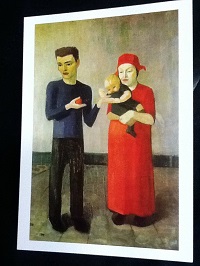
Header Photo: Low resolution detail from the haunting, hypnotic & jaw-droppingly beautiful Farm at Wadenlath by Dora Carrington. Canvas print here. © Estate of Dora Carrington. Ham Spray House, nr. Hungerford, Wilts, 1932 Dora Carrington & Mark Gertler Beautiful Dora Carrington Canvas Prints Dora Carrington Books, Exhibition Catalogues, Dvds and In Depth Reviews Search Site -------------- Dora Carrington's paintings illustrated her life, and the houses she shared with Lytton Strachey were like pictures for living in. Even her letters were works of art. -------------- "Do you know, I am never so happy as when I can paint" ~ Dora Carrington writing to Lytton Strachey, 1932 -------------- 2016: New Dora Carrington Store with some gorgeous prints. -------------- Dora Carrington was an autobiograhical painter, choosing as her subjects the people and places around her and distilling her emotions about them into images of limpid intensity. Her landscapes especially express a heightened sense of place that seems to well up from the unconscious, in the tradition of visionary English artists like Samuel Palmer or Stanley Spencer. Her work, as Michael Holroyd has put it, offers "glowing evidence of her lifelong and passionate involvement with nature and human nature". The lack of public acceptance of her work in Carrington's lifetime was partly due to her obsessive secretiveness and insecurity, so that she hated showing it. Moreover, she didn't fit easily into any one school, and her acutely self-critical nature meant that her paintings rarely lived up to her own expectations. She often gave them away as tokens of friendship, and many disappeared. For years after her death she appeared as a minor figure in the stream of biographies and memoirs about that oddly mesmeric coterie the Bloomsbury Group, in which she is mainly recalled for her unaccountable passion for Lytton Strachey, - openly homosexual and 13 years older than her - with whom she set up house and stayed for their lifetimes. After his death she shot herself, when she was only 38. Yet really from the 1990s gradually her following increased - she would be amazed by the prices her surviving paintings reach today in the big auction houses - and the mid-1990s saw a brilliant biography Dora Carrington enrolled at the Slade in 1910 and was considered one of its star students, along with Mark Gertler (with whom she had a long and painful relationship), Stanley Spencer and Paul Nash. She soon dropped her first name, preferring - like other women artists of the time - to be known by the androgynous "Carrington". She had already revolted against her bourgeois background, and taken to the gipsyish life of students and artists, when at 22 she met and fell irrevocably in At first Lytton's Bloomsbury friends were aghast at this unexpected allegiance; Virginia Woolf acidly described an evening when the couple had retired early, apparently for a night of passion, to be found placidly reading Macaulay aloud in her bedroom. But they were seduced by her ingenous The Bloomberries were also impressed by her nestmaking talent, which offered a happy solution to the problem of where Lytton should live. Her creativity was loving lavished on Tidmarsh Mill, Berkshire and later Ham Spray, Wiltshire, the two houses she found and decorated for Lytton and herself. Elaborate sponging, brushwork and stencilling techniques were used on the walls and furniture ("I started a decoration of the cellar door yesterday. It looks exquisite. A vineyard scene with Boozing Youths, and a fox contemplating the grapes," she bragged to Lytton in 1925; and every object was chosen by Carrington's faultless sense of colour and detail, from Lytton's counterpane to the cracked but exquisite porcelain. On visiting Ham Spray Richard Hughes, the author of A High Wind in Jamaica, was struck by "the extraordinary beauty of the inside of the house - a beauty based on little original architectural distinction ... he (Lytton) looked as if he had been designed as the perfect objet d'art to go with the background of the house." As time went on Carrington, in particular, had to make major compromises for the sake of their menage: she would marry the athletic, goodlooking Ralph Partridge, whom she didn't love, and reject his close friend Gerald Brennan, whom she adored, so that the household would survive. Her (and their) attempts to deal in a civilised manner with "a great deal of a great many kinds of love" were sometimes comic, sometimes agonising. Sometimes she would take refuge in travel, her artist's eye seizing on what was novel and strange. Despite Lytton's spectacular success with two iconoclastic histories, Eminent Victorians and his biography of Queen Victoria, Carrington was often short of money, and took on all manners of decorating commissions for friends and for patrons. Her decorative art was in a seperate tradition from the Omega workshops, and from Bloombury's country seat at Charleston House, decorated with vigorous slapdash brio by Vanessa Bell and Duncan Grant. Her own work owed more to the stylised influences of English and European folk art: her motis, done with wit and delicacy, were circuses, sailors, fairgrounds, nymphs and cherubs, shells and swags, animals and flowers, and scenes of the countryside that she loved. Her restless inventiveness embraced woodcuts, book illustrations, inn signs, decorated tiles, glass pictures, Meanwhile, Carrington loved Lytton for his abilty to live entirely within himself, self-sufficient in his life spent reading and writing, with walks and trips to the post office and visits to friends. But that pre-supposed an adoring "Doric" to cook, housekeep, garden, and entertain a stream of visitors for him. Regular resolutions to do nothing but paint lose out against more pressing demands on her time. "There are so many things for me to do. A lampshade to design, a dresser to paint yellow; Lytton's bed also to paint. Two wood cuts to make and at least 40 letters to write before Christmas ..."
In his wonderfully entertaining 1979 edition Source: Anne Boston, Country Living Magazine, June 1994 Lytton was cremated and his brother James took the ashes which Carrington had wanted to bury under the ilex tree...
Despite every effort of her friends to deflect her from her purpose Carrington made a second attempt upon her life on Friday, 11 March 1932, and succeeded. Wearing Lytton's purple dressing gown, instead of her own yellow one, Carrington shot herself in her bedroom with a gun she had ostensibly borrowed to kill rabbits. Mrs Waters, the carter's wife, made Carrington comfortable at the end; she said that Carrington hoped and prayed she would live long enough to see Ralph one last time and she died not long after he arrived from London.
Carrington was cremated but no one who was there can remember what became of her ashes ...
Source: Art of Dora Carrington Book Carrington (she preferred to be called by her surname as she disliked 'Dora'), was entranced by art at at early age and her parents paid for her to attend extra lessons in drawing. When she won a scholarship to the Slade School of Art in London where she met John Nash and, more importantly, Mark Gertler.
Her association with the Bloomsbury Group was through her long time relationship with Lytton Strachey who she started living with in 1917, and her lesbian relationship with Lady Ottoline Morrell.
She had love affairs with Mark Gertler, and the writer Gerald Brenan. She married Ralph Partridge in 1921. Strachey was also in love with Partridge, and the complexities of this menage were depicted in the film Carrington After Lytton Strachey's death from cancer Carrington found she could not bear life without him; seven weeks later she shot herself.
Art of Dora Carrington Book Review/Buy
Carrington Movie Review/Buy Dvd Recommended Further Reading: Carrington: A Life of Dora Carrington, 1893-1932 Dora Carrington's relationship with the artist Mark Gertler is a fascinating one and worthy of a trivia section all on its own.
|
 by Jane Hill; a new collection of her
  ; and the quiet good
  starring