The Painting
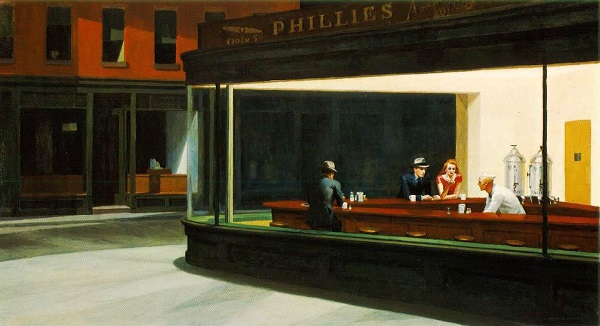
Thus for many people out there who haven't even heard of Hopper they would know of this painting if they saw it. They would have seen it or a repro of it somewhere, sometime. It's become imprinted on the minds of generations due to its omnipresence in our culture. Prints of it, posters, postcards, on the cover of books, people manipulating the image to put a point across, parodies (mostly bad)... Nighthawks has captured the imagination of succeeding generations and will not let go.
My own viewpoint on Nighthawks is that it is the most evocative painting on loneliness in the big city that I have ever seen. Being surrounded in a city by a million people and never feeling more isolated is what Nighthawks captures for me. The power of the piece is in its haunting stillness, a moment stuck in time.
Type: Oil on canvas, 1942
Canvas Size: 84.1 x 152.4 cm (33 1/8 x 60 in.)
Location: The Art Institute of Chicago
© Estate of Edward Hopper
Where in New York is Nighthawks?
The actual location for Nighthawks is intriguing but elusive. According to the artist himself it was inspired by "a restaurant on New York's Greenwich Avenue where two streets meet." I haven't heard of any argument compelling enough to pinpoint its precise location. But it doesn't really matter.
Fluorescent Lights
What is more important to me is the fact that Hopper didn't actually include an entrance or exit to the diner in the picture. Thus the people inside are stuck in their loneliness, nighthawks passing the time under fluorescent lights on a night that will go on forever. Brightly-lit loneliness. We can gaze in on them like a human zoo and every generation since the 1940s has done so but we can't reach them. That to me is the whole point: city dwellers are hermetically sealed in their crowded solitude no matter how many people are around them. Hopper takes three customers and they might as well be an ocean away from each other such is their distance. And around the fluorescent temple there is an ethereal nothingness - no-one on the streets and the buildings opposite seem like corpses in architecture. Beyond the diner there seems like an abyss of darkness and they stay where they are as it seems marginally better to be together when alone inside the bright lights rather than in the darkness without.
The Glass
It's his only painting that shows a curved pane of glass; by doing so it becomes the only glass visible in one of his works.
Edward Hopper said he was "probably painting the loneliness of a large city" but, I think, understandably, didn't want to specify too much what he was trying to convey (isn't it always best for the viewer to feel the picture for themselves?). He added it showed nothing but: "a restaurant on Greenwich Avenue where two streets meet".
— Katherine Kuh: The Artist's Voice. Talks with Seventeen Artists, New York, 1962
Related
I would say a related composition is Sunlight in a Cafeteria, 1958. This is housed at the Yale University Art Gallery, New Haven, Connecticut. Measures 102.2 x 152.7 cm. What Hopper achieved in nighttime with Nighthawks he mirrors it with daylight. Both have the same acute feeling of loneliness for me.
Where Is It Now?
The Art Institute of Chicago purchased the piece in 1942 for $3,000 and it has remained there to this day. How much is it worth today? Can you put a monetary price on it? Must be just below the Mona Lisa and The Scream - in other words, priceless. At around 34 x 60 inches it is bigger than I originally thought and its size just highlights its power.
Find Edward Hopper Prints & Posters:
Nighthawks Fine Art Prints - various sizes, on canvas and on paper on eBay US