A Life

Edward Hopper - Self-Portrait (1925-30)
Whitney Museum of American Art, New York
© Estate of Edward Hopper
Edward Hopper was born in the small Hudson River town of Nyack, New York State, just outside Manhattan, on 22 July 1882.
Several generations of his ancestors were native Americans, originally coming of English, Dutch, and Welsh stock. They were solidly middle-class. When Edward was eight years old, his father purchased a dry goods store and the son sometimes worked there after school.
The young boy's talent for drawing showed itself early: by the time he was ten, he was signing and dating his small sketches. As he grew up and continued drawing, he used himself as a model repeatedly. Several self-portraits of varying sizes, drawn in either pencil or ink when he was eighteen years old, show us a strikingly handsome lad as well as one of a clearly introspective personality.
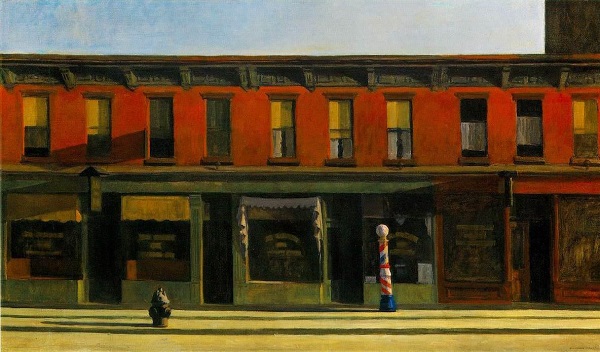
Edward Hopper - Early Sunday Morning (1930)
Whitney Museum of American Art, New York
© Estate of Edward Hopper
At the suggestion of his parents, young Edward took up illustration by way of being practical. Following graduation from high school, he enrolled at the Correspondence School of Illustrating in New York City, taking the short train trip every day from Nyack to get there. The following year he undertook more training of this kind at the New York School of Art (often called the Chase School) founded by the artist William Merritt Chase (1849-1916). He also worked under Robert Henri (1869-1929), one of the fathers of American Realism - a man whom he later described as "the most influential teacher I had."
It was Robert Henri who propagated the colorful "ashcan" approach to art. Studying with Henri meant exposure to some radical ideas and to the varying artistic approaches of some interesting fellow painters: George Bellows, Rockwell Kent, and Guy Pène du Bois. Hopper, the fledgling artist, was one of those solitary, aloof personalities who pursued an independent path despite whatever was in or out of season. At the school, his unmistakable talents were recognized and he won a number of prizes.
Eventually, Hopper was to earn his living for twenty years in the commercial field working in various media--charcoal, pencil, crayon, pen and ink, and watercolor--turning out a variety of posters, advertisements, and illustrations.
While still in his learning twenties, Hopper made three visits to Europe. Though new movements were in full blast in the Paris studios, Hopper remained impervious to most influences in any consistent, doctrinal way. He did admire the Impressionists and their daring experiments with the treatment of outdoor light. As a matter of fact, light became one of the powerful concerns in any painting that Hopper undertook after his return to America.
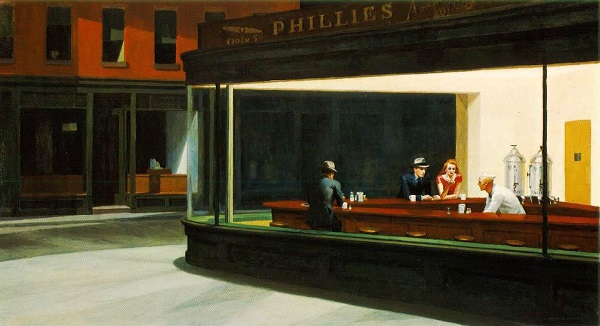
Edward Hopper - Nighthawks (1942)
The Art Institute of Chicago
© Estate of Edward Hopper
By and large, Hopper kept to a style that was essentially austere and, as many said, opposed to charm. It was not at all popular, and it was not until the 1913 Armory Show that Hopper sold his first painting. Even after this, academic juries and dealers in America continued to reject his work, and he sold his next painting only ten years later. It was a watercolor, a new medium that he mastered in addition to etching and oils. When he exhibited a group of watercolors at a New York gallery the following year, the work sold out, and his reputation was finally established.
Hopper settled in Greenwich Village, which was to be his base for the rest of his life, and in 1923 he renewed his friendship with a neighbour, Jo Nivison, whom he had known when they were fellow students under Chase and Henri. She was now forty; Hopper was forty-two. In the following year they married. Their long and complex relationship was to be the most important of the artist's life.
"Ed is the very centre of my universe... If I'm on the point of being very happy, he sees to it that I'm not."
— Jo Hopper's diary
The couple often quarrelled fiercely. Sometimes their rows exploded into physical violence. On the other hand, her presence was essential to his work, sometimes literally so, since she now modelled for all the female figures in his paintings, and was adept at enacting the various roles he required.
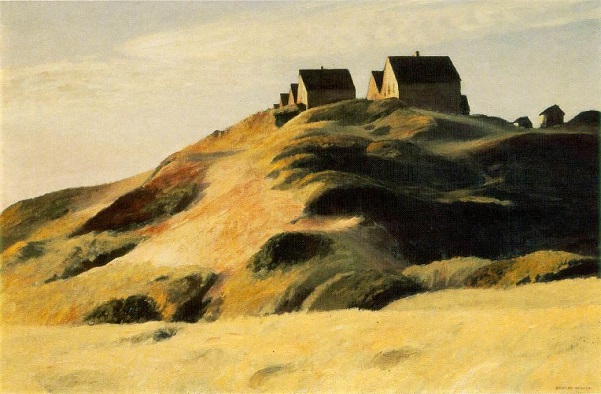
Edward Hopper - Corn Hill (1930)
McNay Art Institute, San Antonio, TX
© Estate of Edward Hopper
It was from the time of his marriage that Hopper's professional fortunes changed. His second solo show, at the Rehn Gallery in New York in 1924, was a sell-out. The following year, he painted what is now generally acknowledged to be his first fully mature picture, The House by the Railroad. With its deliberate, disciplined spareness, this is typical of what he was to create thereafter.
His paintings combine apparently incompatible qualities. Modern in their bleakness and simplicity, they are also full of nostalgia for the puritan virtues of the American past. Though his compositions are supposedly realist they also make frequent use of covert symbolism. Hopper's paintings have been aptly compared to the realist plays of Ibsen, a writer whom he admired.
By this time Hopper, whose career, once it took off, was surprisingly little affected by the Depression, had become extremely well known. In 1929, he was included in the Museum of Modern Art's second exhibition, Paintings by Nineteen Living Americans, and in 1930 The House by the Railroad entered the museum's permanent collection. In the same year, the Whitney Museum bought Hopper's Early Sunday Morning, its most expensive purchase up to that time. In 1933 Hopper was given a retrospective exhibition at the Museum of Modern Art. This was followed, in 1950, by a fuller retrospective show at the Whitney.
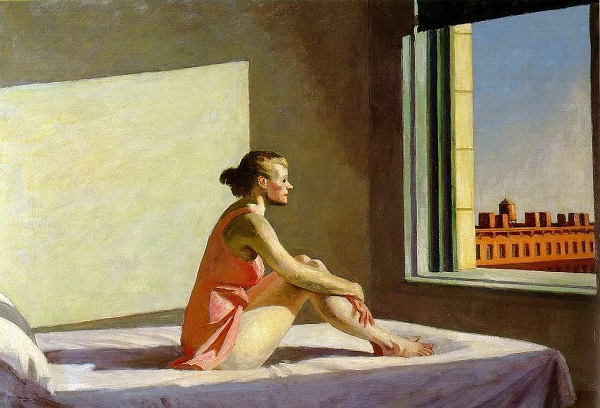
Edward Hopper - Morning Sun (1952)
Columbus Museum of Art, Ohio
© Estate of Edward Hopper
He died in 1967, and Jo Hopper died ten months later.
Hopper's career spanned a period of almost sixty years. His subject matter was the physical face of America in city, town, and countryside, and his avowed aim was to render it with the most exact transcription possible of his impressions. This he did with an uncompromising realistic technique and with a powerful handling of light that eerily promotes the underlying starkness of his artistic vision.
"No artist has painted a more revealing portrait of twentieth-century America. But he was not merely an objective realist. His art was charged with strong personal emotion, with a deep attachment to our familiar everyday world, in all its ugliness, banality, and beauty."
— Lloyd Goodrich
Gallery


