Biography
Giorgio de Chirico was born to Italian parents in Vólos, Greece, on July 10, 1888. He would become the founder of Metaphysical art (Pittura Metafisica), creating some of the most mysterious and enigmatic paintings of the 20th century—empty plazas, elongated shadows, classical architecture, and impossible perspectives that would profoundly influence Surrealism.
"De Chirico navigates the reality of the surreal."
— Paul Page
In 1900, he began studies at the Athens Polytechnic Institute and attended evening classes in drawing from the nude. Around 1906, he moved to Munich, where he attended the Akademie der Bildenden Künste.
It was at this time he became interested in the art of Arnold Böcklin and Max Klinger and the writings of Friedrich Nietzsche and Arthur Schopenhauer. These philosophical influences would deeply inform his artistic vision, leading to the creation of works that seemed to exist outside of time—silent, sun-drenched plazas inhabited only by shadows and classical statuary.
Rare signed prints, books, and authenticated works
Paris & the Birth of Metaphysical Art
De Chirico moved to Milan in 1909, to Florence in 1910, and to Paris in 1911. In Paris, he was included in the Salon d'Automne in 1912 and 1913 and in the Salon des Indépendants in 1913 and 1914.
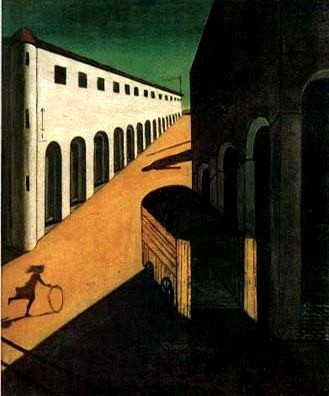
As a frequent visitor to Guillaume Apollinaire's weekly gatherings, he met Constantin Brancusi, André Derain, Max Jacob, and others. It was during this period that de Chirico began creating the mysterious architectural landscapes that would define his legacy—works featuring deserted Italian piazzas, long shadows cast by invisible suns, classical statues, and an atmosphere of profound enigma.
These paintings exist in a realm between dream and reality, classical past and modern present. They influenced the entire Surrealist movement, yet remained uniquely de Chirico's—more philosophical than psychological, more architectural than organic.
The Scuola Metafisica
Because of the war, in 1915, de Chirico returned to Italy, where he met Filippo de Pisis in 1916 and Carlo Carrà in 1917. Together, they formed the group that was later called the Scuola Metafisica (Metaphysical School).
The artist moved to Rome in 1918 and was given his first solo exhibition at the Casa d'Arte Bragaglia in that city in the winter of 1918-19. During this time, he was one of the leaders of the Gruppo Valori Plastici, with whom he showed at the Nationalgalerie in Berlin.
From 1920 to 1924, he divided his time between Rome and Florence. A solo exhibition of de Chirico's work was held at the Galleria Arte in Milan in 1921, and he participated in the Venice Biennale for the first time in 1924.
Museum-quality prints of metaphysical masterworks
International Recognition
In 1925, de Chirico returned to Paris, where he exhibited that year at Léonce Rosenberg's Galerie l'Effort Moderne. In Paris, his work was shown at the Galerie Paul Guillaume in 1926 and 1927 and at the Galerie Jeanne Bucher in 1927.
In 1928, he was given solo shows at the Arthur Tooth Gallery in London and the Valentine Gallery in New York, establishing his international reputation.
In 1929, de Chirico designed scenery and costumes for Sergei Diaghilev's production of the ballet Le Bal, and his book Hebdomeros was published. The artist designed for the ballet and opera in subsequent years and continued to exhibit in Europe, the United States, Canada, and Japan.
In 1945, the first part of his book Memorie della mia vita (Memoirs of My Life) appeared, offering insights into his artistic philosophy and creative process.
Later Years & Legacy
De Chirico died on November 20, 1978, in Rome, his home for over thirty years. By the time of his death, he had created a body of work that fundamentally changed the direction of 20th-century art.
His influence on Surrealism was profound and immediate. Artists like Max Ernst, Salvador Dalí, René Magritte, and countless others absorbed the lessons of his mysterious plazas and impossible architectures. Yet de Chirico remained apart from Surrealism, pursuing his own unique vision of metaphysical painting.
His early metaphysical works—created between 1910 and 1920—remain among the most iconic images in modern art. These paintings of empty Italian squares, elongated shadows, classical statuary, trains, and arcades exist in a space between memory and dream, reality and illusion.
The enigmatic quality of these works has never been fully explained, which is perhaps their greatest strength. They invite interpretation while resisting definitive answers—much like the mysteries of existence that fascinated de Chirico throughout his life.
Explore the Metaphysical art movement
Gallery
A selection of representative paintings from his career

The Child's Brain
© Estate of Giorgio de Chirico
Additional Works
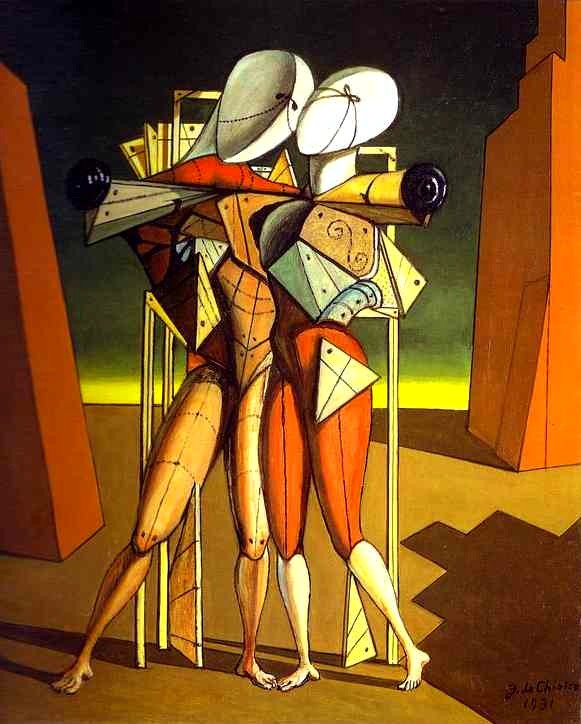

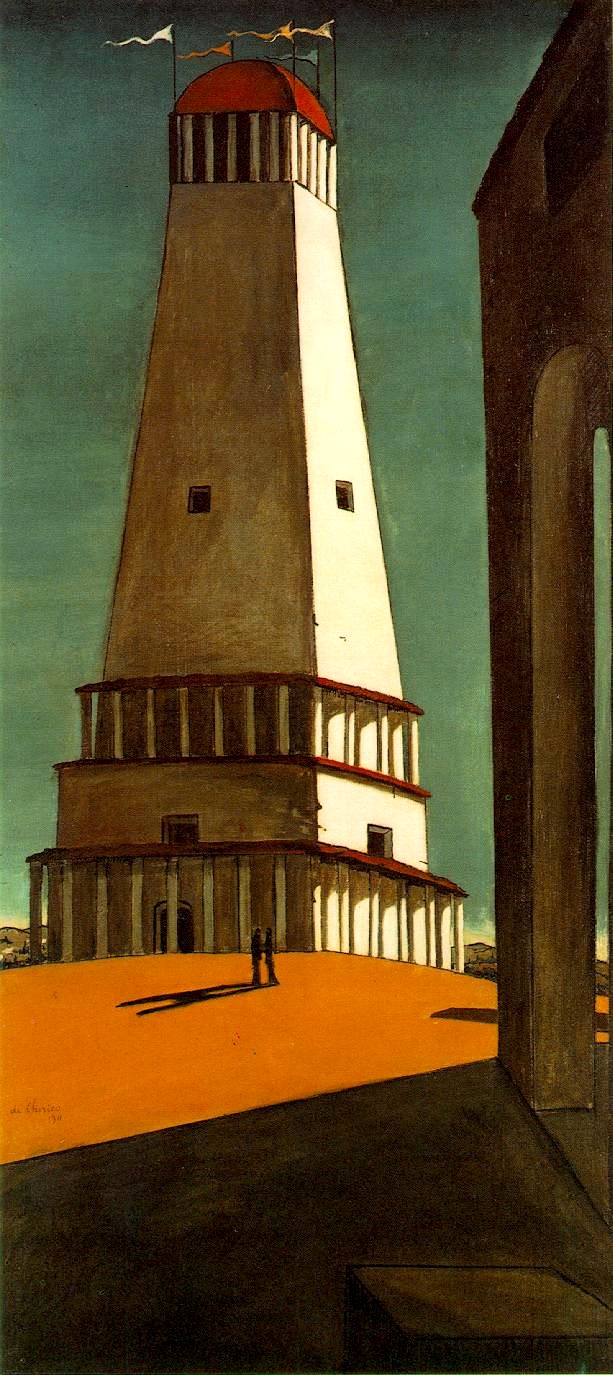
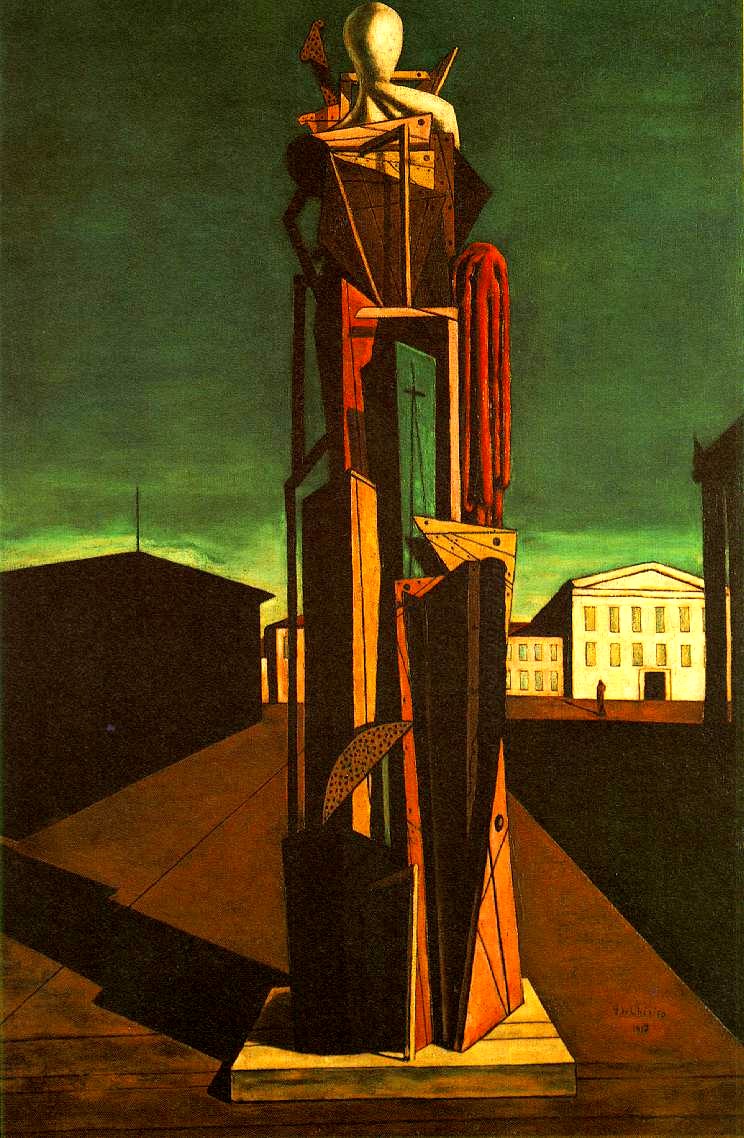
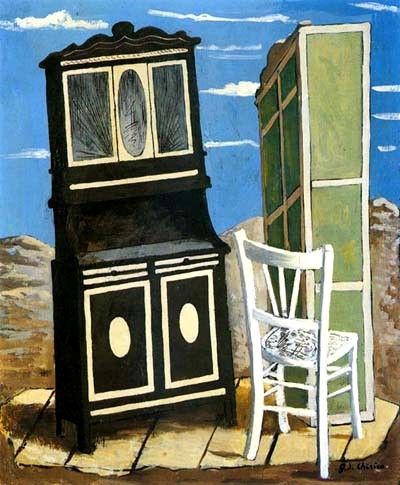
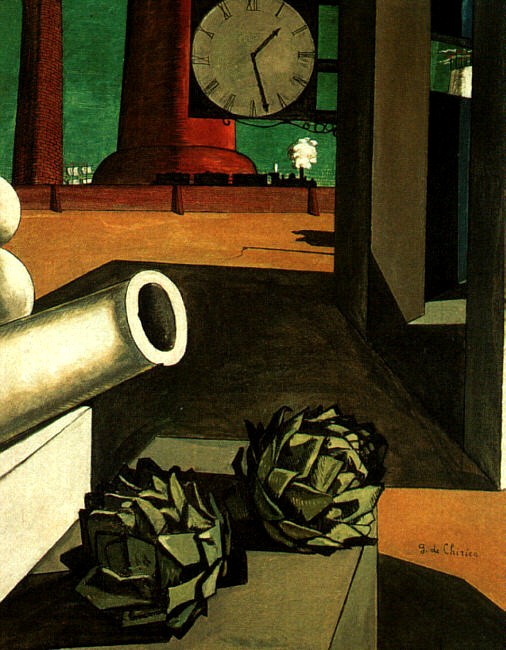
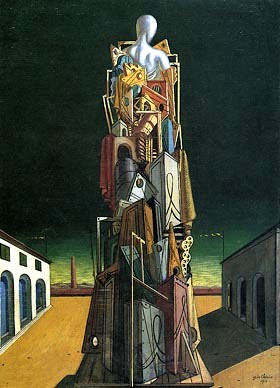
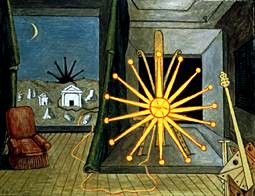
Click images to view full size
Exhibition catalogues, monographs, and art books
The Uncertainty of the Poet
View The Uncertainty of the Poet →
One of de Chirico's most famous works, The Uncertainty of the Poet, perfectly encapsulates his metaphysical vision. The painting features a classical torso, a bunch of bananas, a train, and an arcade—seemingly unrelated objects brought together in a mysterious Mediterranean plaza.
The juxtaposition creates a sense of profound unease and mystery. What does it mean? Why these objects? The painting refuses easy interpretation, existing instead in a realm of pure enigma—the uncertainty that gives the work its title.
All images © Estate of Giorgio de Chirico
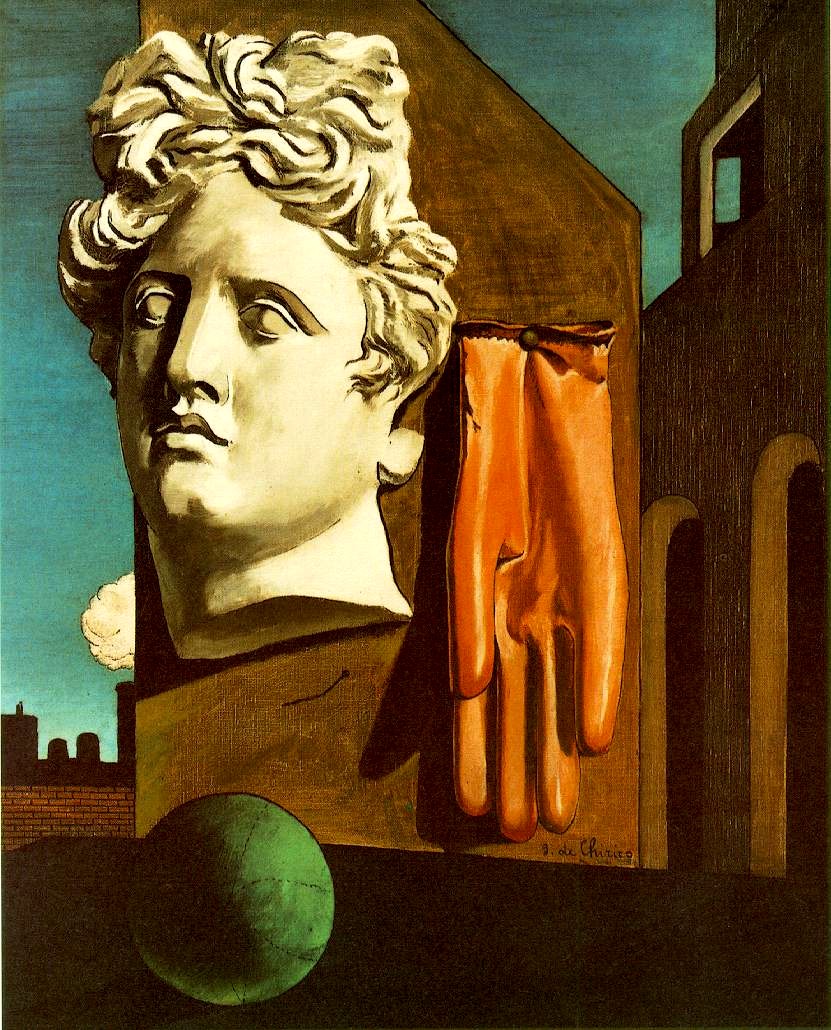
Header painting: Love Song by Giorgio de Chirico, Oil on canvas