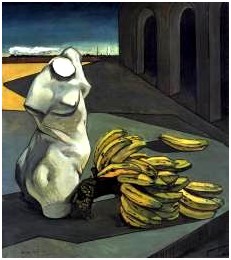
The Uncertainty of the Poet, 1913
Oil on canvas
© Estate of Giorgio de Chirico
About the Painting
"De Chirico finds the surreal revolution in the most traditional of art forms."
— Paul Page
Surrealism as a movement took its inspiration from many sources. It evolved from Dada, an earlier, nonsensically named art movement. In the early years of the twentieth century, Dada artists promoted anarchy and experimentation in modern avant-garde art.
Although Surrealism evolved out of the disruptive, tragi-comic manifestations of Dada, it also acknowledged the influence of more traditional artists, ranging from the Symbolists and Romantics of the nineteenth century to the work of Italian artist Giorgio de Chirico.
The Futurist movement, which also flourished in Italy at this time, looked to France and to Cubism. De Chirico, however, looked to the Renaissance and ancient Roman art. What made his work avant-garde was the manner in which he distorted the Classical and Renaissance sense of calm, balance, and harmony.
Rare signed prints and authenticated works
Analysis & Interpretation
Ancient Italian art idealized the human figure, depicting a rational world in which the viewer could feel confident and optimistic. De Chirico introduced distortions into apparently rational scenes and in so doing made his pictures seem more worried and disturbing.
The Uncertainty of the Poet has made an unexpected juxtaposition of a twisted classical female torso with a bunch of bananas. This combination suggests many diverse interpretations, yet remains enigmatic and dream-like.
The painting features several key elements that create its mysterious atmosphere:
The Classical Torso: A fragmented female statue, reminiscent of ancient Greek or Roman sculpture, stands prominently in the foreground. Its placement and truncated form suggest both classical beauty and modern fragmentation.
The Bananas: An unexpected bunch of bananas sits beside the statue—mundane, organic, tropical, completely at odds with the classical marble and Italian architecture. This juxtaposition is at the heart of the painting's enigma.
The Architecture: In the background, we see the characteristic de Chirico arcade—deep shadows, elongated perspectives, classical columns creating mysterious spaces that seem to exist outside of normal time.
The Train: A train appears in the distance, adding to the sense of journey, displacement, and the intersection of different worlds and times.
Influence on Surrealism
This painting, created in 1913, preceded the official Surrealist movement by more than a decade. Yet it contains all the elements that would define Surrealism: the unexpected juxtaposition of unrelated objects, the dream-like atmosphere, the sense that rational reality has been subtly warped.
André Breton and the Surrealists recognized de Chirico as a crucial precursor to their movement. His metaphysical paintings demonstrated that mystery and the unconscious could be evoked not through abstract forms but through precise, almost hyper-realistic depictions of impossible combinations.
The "uncertainty" in the title refers not just to the poet's uncertainty, but to the viewer's uncertainty in interpreting the image. What does it mean? Why these objects? The painting refuses definitive answers, existing instead in a realm of pure enigma—inviting interpretation while resisting conclusion.
This approach—creating mystery through clarity rather than obscurity—influenced countless artists. From Magritte's philosophical paradoxes to Dalí's precise rendering of the impossible, the legacy of de Chirico's metaphysical vision runs throughout Surrealist art.
Museum-quality prints of metaphysical masterworks
© Estate of Giorgio de Chirico
"The Uncertainty of the Poet" remains one of the most enigmatic and influential paintings of the 20th century