Film Review
Released: 1930
Producer: Jean Cocteau
Editor: Jean Cocteau
Commentary: Jean Cocteau
Scenario: Jean Cocteau
Sound: Henri Labrely
Music: Georges Auric
Cinematographer: Sacha Mansour
Cast: Lee Miller (statue), Enrique Rivero (poet), Pauline Carton (child's tutor), Feral Benga (black angel)
Film Produced: April-September, 1930
Premiere: Paris, January 20, 1932
Released in U.S.: November 13, 1933
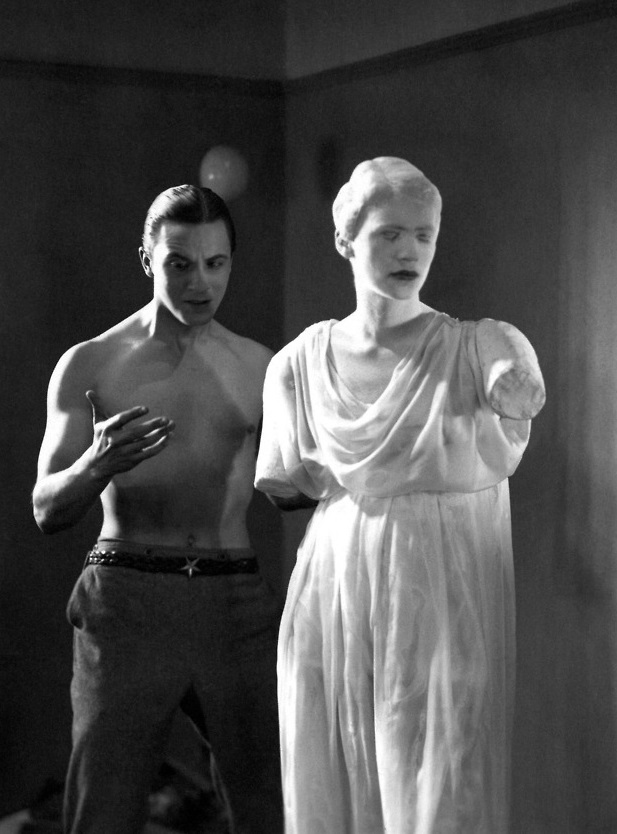
Still from 'The Blood of a Poet', 1930
There has never been a film like Le Sang d'un Poète (The Blood of a Poet). It was not only the first film made by Cocteau, one that ignited another satisfying scandal, but it brought all his diverse talents into focus in a medium that was new to him. The work represents an aesthetic milestone in Cocteau's career.
The idea of a film had its germination during a house party given by Charles and Marie-Laure de Noailles at Hyères in 1929. Georges Auric, Cocteau's lifelong musical collaborator, surprised his hosts by announcing that he wanted to compose the score for an animated cartoon.
Cocteau was asked on the spot to provide a scenario. After some discussion, the Noailles agreed to give Cocteau a million francs to make a real film with a score by Auric. This became The Blood of a Poet, still one of the most widely viewed of all Cocteau's screenworks.
Cocteau described its disturbing series of voyeuristic tableaux as "a descent into oneself, a way of using the mechanism of the dream without sleeping, a crooked candle, often mysteriously blown out, carried about in the night of the human body."
Own this groundbreaking masterpiece on DVD
Happy Accidents
Still from 'The Blood of a Poet', 1930
Technically, The Blood of a Poet reflects Cocteau's trials and errors as a novice filmmaker who had to turn irreversible mistakes to his advantage and improvise every celluloid foot of the way. During shooting, he used the dust raised by studio cleaning men to enhance the mysterious atmosphere of the final scenes.
Special weightless effects were obtained by camera trickery to show the little girl flying up to the ceiling and the poet moving painfully along the corridor wall. Once Cocteau discovered that he could turn shooting disasters into happy accidents, he was off on a career of making films that carried his cachet of surprises.
The miraculous mirror and mercury scene in Orphée, the live arms holding candelabra from the walls of La Belle et la Bête, and the accelerated time sequences of flowers opening in Le Testament d'Orphée are only a few of his trucs.

Symbol and Scandal
The Blood of a Poet, like so much of what Cocteau created, abounds in autobiographical motifs: the macho Dargelos and the snowball fight, the opium smoker, the poet with his sexual stigmata, and the gunshots that, intentionally or not, echoed his father's suicide long before.
Cocteau himself always denied the presence of hidden symbolism in the film, but word got about that it had anti-Christian undercurrents. This greatly distressed the Noailles. After the scandal caused the Viscount to be expelled from the elegant Jockey Club, and even brought threats of excommunication from the Church, they forbade Cocteau to allow public release of The Blood of a Poet for over a year.

Lee Miller
Luis Buñuel's film, L'Age d'Or, similarly financed by the Noailles at the same time, had indeed violently attacked the Church and the military. Its premiere at Studio 28 in November 1930 set off riots by ultraconservatives, who threw stink bombs, shouted protests, and spattered ink in the time-honoured manner of Parisian demonstrators ever since Victor Hugo's Hernani in 1830.
The Surrealists, including Breton, Dalí, and Tzara, noisily defended Buñuel's film and derided Cocteau's. It was no doubt this brawling furore that made the Noailles suppress Cocteau's film and leave Paris until the storm blew over.
The commotion over The Blood of a Poet further upset Jean Cocteau because Valentine Hugo, his old friend from Le Pirquey days, had now become the mistress of André Breton, Cocteau's unrelenting Surrealist foe. This alliance kept Valentine and Jean apart for the rest of their lives.
Explore Cocteau's complete cinematic legacy
All images © Estate of Jean Cocteau