
the threepenny opera
(1931)
cast
story
background
subtext
verdict
bertolt brecht
g.w. pabst
kurt weill
fatty arbuckle
charlie chaplin
d.w. griffith
jean harlow
howard hawks
katharine hepburn
buster keaton
harold lloyd
groucho marx
george raft
robert ryan
jean simmons
josef von sternberg
andy warhol
orson welles
- the
threepenny
opera
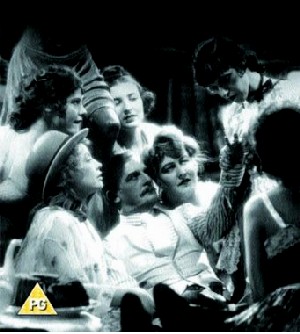
"Brecht, Weill & Pabst in the same room!
[ g . w . p a b s t | m a s t e r p i e c e ]
Genius seemed to have been handed out at will in the 1930s."
- Paul Page
cast | story | background | subtext | verdict
die dreigroschenoper
louise brooks | g.w. pabst
bertolt brecht | kurt weill
jean simmons | andy warhol | orson welles
Of course with writing by Brecht, with music from Weill and with Lotte Lenya appearing it would be hard not to make 'art' out of this but then there is 'art' and there's 'this'. Superb. From the stage sets to the 'ende'...astonishment. I'm probaly alone in this but hearing the power of The Ballad of Mack the Knife both at the start and the finish I do wish it hadn't been subsequently softened and made more famous in the various swing versions, in particularly Bobby Dain's one. The essense of the song just isn't there, on the lips of popular light entertainers - it's gruff and raw and has its home in the mouth of the street singer. It's a hymn to the raw guts of poverty, to the basic unfairness of life in those times which is still accurate today. It is not for swinging in any popular pop charts. Rudolf Forster (1884 - 1968) as Mackie Messer is a revelation. He would have been around 46 when he played the part. He has the gravitas to pull it off - an evil man under a beautiful bowler hat. Doesn't that say it all? I like Brecht's words at the end of The Threepenny Opera from Mack the Knife about rich and poor: Therefore some live in darkness With that, he turns film on its head. A pat ending, a happy ending, was and is the stable diet of any film. Here it's just left as how life is. Nothing more, nothing less. Depressing, but true. There's a fundamental of life here. If the poor really understood how much the rich needed them then the world would be a far better place. Dvd Available: amazon.com (direct link) The above Criterion Collection release has a beautiful cover. View here. die dreigroschenoper (1931) Crew: Director G.W. Pabst, Writers Bertolt Brecht, Bela Balazs, Leo Lania and Ladislaus Vajda, Producer Seymour Nebenzal, Music Kurt Weill,Cinematography Fritz Arno Wagner, Production Design Andrej Andrejew The following morning, Polly returns home to her parents. We learn thather father is Mackie's only real rival in the city, since he controls all thebeggars in London. No one can work here without his licence. Peachum isfurious when he finds out what his daughter has done, claiming that she is aromantic fool for not seeing through Mackie. He decides he must save hisdaughter and so goes to the police. Of course Tiger Brown doesn't want tointervene against his friend. But Peachum has an ace up his sleeve. If Browndoesn't help him, Peachum will organise his beggars to disrupt the coronation which is to take place shortly, a disturbance which could cost Brownhis job. Polly rushes back to her husband to warn him about her father. At firstMackie won't believe her. Finally he accepts that things are serious so he decides to flee, leaving his business in the hands of Polly, a decision whichis greeted with a good deal of derision by his gang. After a romantic farewell, Polly returns to the gang, immediately stamping her authority on themen and leaving them in no doubt that she is more than just a silly romanticgirl. Rather than run away, Mackie decides to indulge in his usual weeklyvisit to Jenny's brothel, even stopping to admire his own wanted poster onthe way. But while Mackie is being cocky about his chances of arrest, MrsPeachum is inside the brothel telling Jenny about the wedding to her daughter. Jenny is heartbroken and so agrees to betray her lover to the police when he arrives. This she does but almost immediately regrets it since, when Mackie arrives, he is his old charming self. Remorseful, Jenny warns him that the police are coming and helps him escape. On his way out he meets yet another woman who takes his fancy and decides to hide out with her for a while. Deciding the coast is clear (and having finished making love to the woman) he leaves her, only to run smack into the police and so he is taken off to jail. Meanwhile, Peachum is furious, thinking Mackie has escaped and so makes up his mind to carry out the threat he made to Brown and to disturb the coronation. The day of the coronation arrives and Peachum fires up his beggars to go and disrupt events. But the film now takes a strange twist. Things have changed within the gang under Polly's officious leadership. Rather than continuing with burglary they have opened a bank, a far more effective way of ripping off society. Mackie is now the bank president. Mrs Peachum tells her husband the news and he immediately tries to call off the demonstration. Mackie is now a man to be reckoned with and so is a perfect match for his daughter. However, the beggars won't be calmed and so the demonstration goes ahead. Mackie breaks out of jail to take charge of the bank. With the beggars rioting, Brown realises he is ruined and rides to the bank to look for his friend, who promptly tells him not to worry and offers him a partnership in the bank. Finally Peachum turns up in Mackie's office. Having experienced the riot he now truly understands the power of the poor masses and so he offers Mackie another partnership, between the bank's money and his influence with society's underclass. Together they can run everything. And so all ends 'happily' with the three men working together for mutual benefit. The main difference between the film and the stage play is the use ofrealism, undermining the principles of 'Epic Theatre.' No matter: it works. Also, Weill's beautifully grating songs, which provide a powerful commentary on the stage narrative, are kept to a minimum here and because of that are eagerly awaited. Inits own right this is an important film and it does manage to keep someof the feel of the stage play (indeed, some of the main characters are playedby the same actors, including Kurt Weill's wife, Lotte Lenya as Jenny).Also, the street performer who sings the 'Ballad of Mac the Knife' (madefamous in English by Louis Armstrong), sporadically addresses the audience directly to comment on the narrative and in so doing gestures towardsBrecht's notion of 'Defamiliarisation.' In terms of film style, there is adegree of continuity with Die Buchse der Pandora. We see the same use ofshadows, harking back, as Eisner points out, to the chiaroscuro lighting usedduring Expressionism. But particularly impressive in this film are AndrejAndrejew's sets, for which he constructed a huge, half-real, half-fantasyimage of London at the turn of the last century, crammed with dark labyrinthine passages which again recall the Expressionistic world of Wiene (now he was underrated) and Lent. The power of capitalism, for Marx, is its ability to hide the fact that it isbased on exploitation. It appears to offer the worker a stable means of earning a living, when all it is doing is turning the worker into its slave. The tension between appearances and reality, which is at the heart of Marxistphilosophy, runs throughout Pabst's film. As the street performer tells us inhis song, the shark's teeth are never on show, just as the dandified appearance of Mackie belies the viciousness of his crimes, or the sugar-drenchedsoppiness of Polly and her husband's scenes together hides the fact thattheir marriage is a ruthless business arrangement which eventually bringsthe heads of the city's two main crime families together. The poor, the people who have the least to gain under capitalism, simply fall for the trick thattheir rulers play on them. At the end of the film, the beggars run out of control, hinting at the power of the proletariat and their revolutionary potentialto change society. But rather than suggesting that this potential will one daybe realised we see Peachum, their boss, go into partnership with big business to manipulate his people more effectively.
personal opinion
To me, the director G.W. Pabst is the most underrated director of all time. Along with Lang and Murnau he is part of the Holy Trinity of filmmaking and here it is, one of his best. I remember seeing an interview with Louise Brooks in her later years and she expressed admiration for Pabst and his attention to detail. In that respect he reminds me of Carol Reed.
And others live in light
We see those who live in brightness
But those in darkness are lost to sight
Cast: Rudolf Forster (Mackie Messer), Carola Neher (Polly Peachum),Reinhold Schunzel (Tiger Brown), Fritz Rasp (Peachum), Valeska Gert(Mrs Peachum), Lotte Lenya (Jenny), Hermann Thimig (The Priest), ErnstBusch (The Street Singer), Vladimir Sokoloff (Smith, The Jailer), PaulKemp, Gustav Puttjer, Oskar Hocker, Krafft-Raschig (Mackie Messer'sGang Members), Herbert Grunbaum (Filch)
Story: London at the turn of the last century. Enter Mackie Messer (Mackthe Knife in English), a dandified master criminal in bowler hat and whitegloves, who is walking out of a brothel. Here he has been enjoying thecharms of Jenny the prostitute. As he says his fond farewell he is distractedby the beautiful Polly Peachum. He ditches Jenny and follows the otherwoman. The next thing we know, Mackie has proposed to Polly and is marshalling his gang to organise the wedding, no mean feat since this alsoinvolves robbing enough furniture for his bride's trousseau. The ceremonytakes place that night in a deserted warehouse and who should appear at thistop crime boss' celebration but Tiger Brown, the head of the police! It turnsout that Mackie and Brown are old army buddies and we discover the secretof Mackie's success. As long as Brown is running Scotland Yard, Mackiecan carry out his burglaries without any fear of being arrested.
background
Pabst's film is based on the hugely successful stage musical by Bertolt Brecht and Kurt Weill. The Marxist playwright Brecht was one of the most important dramatists of the twentieth century, and was a central figure of the early German avant-garde, of which literary Expressionism was a key element. Rather than trying to write realistic plays, Brecht wrote what he termed 'Epic Theatre.' Central to this was his Verfremdungseffekt, or "Defamiliarisation Effect.' By having his actors step outof character, or by using ironic captions to introduce episodes, he would never allow the audience to forget that they were watching a play and not real life. Through these techniques he hoped that he would provoke hisaudience into thinking more carefully about the events they had seen. Die Dreigroschenoper was Brecht's first big stage hit and the film his first foray into the world of movies. However, although initially collaborating in the writing of the screenplay both Brecht and Weill soon began to feel that thefilm was compromising their aesthetic and political intentions and so tookthe film company, Nero films, to court. A very public lawsuit ensued which saw Brecht eventually lose and Weill settle out of court.
subtext
Die Dreigroschenoper is a satire on the nature of capitalism. Ina sense it can be seen as a more radical version of M (a film clearly influenced by Brecht's play as can be seen in Fritz Lang's use of the beggars as spies),or as a comic reworking of Dr Mabuse. The central message is that bourgeois society is based on the crime of private property and that there is ultimately no difference between the burglar and the banker, apart from the factthat, as Polly points out in a wonderfully pithy monologue to the rest of thegang, the banker is better off because he is protected by society's laws.
verdict
Visually this is great. Maybe Pabst should have included more of Weill's songs but I for one think it's a masterpiece of filmmaking. 5/5

cast | story | background | subtext | verdict
die dreigroschenoper
louise brooks | g.w. pabst
katharine hepburn | harold lloyd | g.w. pabst
jean simmons | andy warhol | orson welles

Page created by: ihuppert5@aol.com
Changes last made: 2016

