| Les Chants des Maldorer
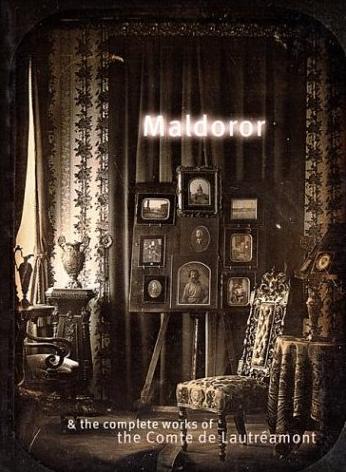
Surrealist Iconography Biography Les Chants des Maldorer Books Art & Antique Store Search Site The three earliest complete editions (Lacroix, Verboeckhoven: Brussels 1869; E. Wittman: Paris and Brussels 1874; and L. Genonceaux: Paris 1890) supply the text generally accepted by twentieth-century editors. Chant Premier was published seperately and anonymously by Balitout, Questroy et Cie., Paris, in August 1868, and subsequently reprinted at Bordeaux in Evariste Carrance's anthology Parfums de l'Ame (January 1869. Lautreamont revised this section for the Lacroix, Verboeckhoven first edition, making mostly insignificant changes, of which the principal was the decision was the deletion of various specific references to one Georges Dazet, a former schoolmate who would be a dedicatee of the later Poesies. I prefer Lautréamont's final revised version - the flawless impersonal pearl rather than the rough-edged oyster. So do most editors, although the earlier version is occasionally reprinted, notably in Soupault's 1958 rdition. Censorship problems and wary publishers were responsible for the book's not being sold in France in Lautreamont's lifetime; copies of the early editions are extremely rare. Until almost half a century later, when Cendrars and the Surrealists Breton and Soupault hailed Lautreamont as a forefather who with Baudelaire and Rimbaud< was part of an unholy Trinity of genius, this exciting and revlutionary classic remained truly an 'underground' work, little discussed and less read. Lautreamont's dazzling style with its wild pyrotechnics welded poetry and parody into a coherent and beautiful structure, full of sensitivity as well as strength. I hope this translation of Les Chants des Maldorer - the first compete annotated edition to be generally available in the UK - may persuade readers to try the Count in French. For faced with strange puns and punctuations; with curious syntactical constructionswhich weave unexpected opposites into daring new patterns; with grim humour continually dissolving ecstatic lyrical flights in a cloud of ambiguous and teasing commas, a translator can only approximate. The first English translation, Rodker's in 1924 is, alas, an archaic travesty, full of elementary errors and misreadings, not to mention misprints ('Satan for 'Sultan', and other gems), while Wernham's 1943 Americanese is even worse. Mr Wernham is guilty of the crassest mistakes on every page (la pale voie lactee becomes 'the pale milky voice'; les comedians les plus extraordinaires, 'the most outlandish clowns'; egorge, 'disembowels', etc.etc., ad infinitum) and, accuracy apart, even has difficulty with the English language: 'prideful', 'snuff up', 'afflict upon me', etc., shamelessly litter his pages. I do not wish to seem churlish towards my predecessors, but my main aim is the restoration of a previously mutilated and misrepresented text. I believe that the lack of recognition in this country for one of France's great writers is unfortunate, and I hope this translation will help to redress the balance on its author's behalf. ALEXIS LYKIARD, Translator's Preface to Lautreamont's Maldorer. Available at amazon.co.uk and his chief executor was the Marquis de Sade" - Henry Miller
no easier to judge or place, is perhaps Ted Hughes's Crow. Maldoror and Crow would recognize each other; they would cackle at the back of the class" - The Times |
 |
| 

 |
| 