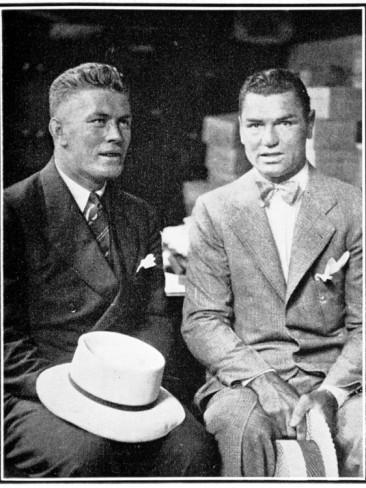
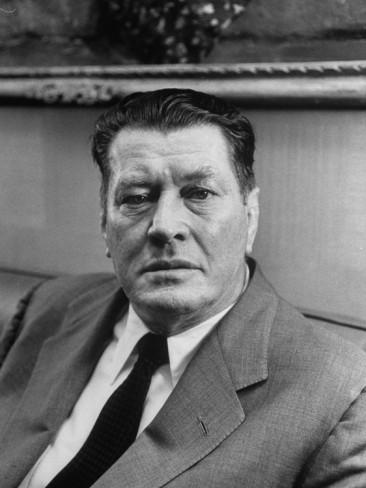
| Gene Tunney Gene Tunney has to be among the most underrated fighters that ever lived. I think it is because of the 'long count' fight with Jack Dempsey - that seems to have taken over the history of the man until it's all anyone talks about. But he was so much more to him than that: just one loss (and that was at light heavyweight) in an 86 fight record; an intellectual who treated fights like a game of chess, thinking his way into fights; stylish; good looking in a James Dean/Paul Newman mesmirising sort of way; and wealthy. He had it all and yet today his name is forever linked to Dempsey's and their two fights. Seems unfair as he has got to be in the top ten of anyone's greatest heavyweight boxers ever. Why is he not better known today? I think because the American public of the day prefered their fighters to be sluggers like Dempsey and he was more cagey. And, of course, because he beat the iconic Dempsey. Anyway the 'Long Count wasn't Tunney's fault. It was the Dempsey camp who stipulated in the fight contract that a boxer had to retreat to a neutral corner (strange that, when you see the Willard fight) and, to be fair, Dempsey never complained about it afterwards. I warmed to Gene Tunney far more than I did for Jack Dempsey. Maybe it's because of his understated way; maybe I like his more subtle way of fighting. Maybe because his genius is not shoved down your face. Interesting fact (well, interesting to me) is both the Dempsey fights attracted crowds of over 100,000 in the late 1920s. Now there is unlikely to be a living soul left who witnessed these fights. So we have no direct link to these two immortal moments in the ring; our last living memory to those two nights have gone. Seems sad somehow. Real name: James Joseph Tunney Boxing record THE FIGHTING MARINE: The boy from a working-class Irish family was raised in New York's Greenwich Village then worked as a clerk until he joined the US Marine Corps and served in France in the First World War until the Armistice. Tunney's fighting took place in the boxing ring and he returned home as champion of the American Expeditionary Force. His old job gone, he became a professional boxer and set his sights on Jack Dempsey, famed and feared heavyweight champion of the world. He beat him twice. In 1928 he retired as undefeated champion and a millionaire to marry a beautiful heiress to the Carnegie steel fortune. As successful in business as boxing, Tunney became a captain of industry. His circle of friends included the President and such writers as Thornton Wilder and George Bernard Shaw. Paul Page, Dec. 2012 MORE: Like Louis/Schmeling a generation after he became good friends with Dempsey when their careers ended. Dempsey even campaigned for Tunney's son John V. Tunney when he ran for the U.S. Senate. The first fight with Dempsey in Philadelphia in 1926 attracted 135,000 fans. The second fight at Soldier Field in Chicago attracted a crowd of 145,000. When he retired from boxing in 1928 he lived much of his life in Stamford, Connecticut. He lectured on Shakespeare at Yale. He was friends with Ernest Hemingway, H.G. Wells, John Marquand and Somerset Maugham. After he retired he rarely went to fights and had little interest in boxing. Veteran New York sports columnist Frank Graham said of Tunney in 1961: "No athelete ever succeeded in obscuring his own great skills so completely." Though he died rich, Tunney came from a poor background in Greenwich Village. Billy Gibson was his last and most influential manager. His wife, Polly Lauder, inherited an estimated $50 million ($1.5 billion by today's standards. Tunney was wealthy in his own right; he made $1 million ($11 million today) from the second Dempsey fight. He had four children. He was the chief executive officer of the McCandless Corporation, a conglomerate of rubber products companies based in New York. He retired from boxing at the age of 31. FURTHER READING: Tunney: Boxing's Brainiest Champ and His Upset of the Great Jack Dempsey These prints are available at: amazon.com Gene Tunney signed items @ ebay.com (direct link to signed items) - grab yourself a Tunney treasure The Prizefighter and the Playwright: Gene Tunney and George Bernard Shaw (available: amazon.com) A beautifully written book on a fascinating and little-known subject. In setting down the tale, Jay Tunney frequently had to play detective in reconstructing a credible chronology of events that took place in the very house he grew up in. To his credit, his approach for the most part reflects a scholarly and meticulously researched narrative so attuned to the facts that one has to periodically remind oneself: this is his father he is writing about. (George Kimball Irish Times 2010) The brawny man and the brainy man often find themselves at odds, each denigrating the other's gifts. The man of the body bullies, while the man of the mind retreats to intellectual arrogance. Such was not the case with 1920s heavyweight boxing champion Gene Tunney and famed playwright George Bernard Shaw, who forged a close relationship, recalled here by one of Tunney's sons. Despite humble beginnings and his chosen profession, the Irish American Tunney was a self-taught lover of the arts who strove to raise himself in society, marrying into the upper class and rubbing shoulders with other literary giants of his time, while the Irish Shaw, several decades older, had dabbled in boxing as a young man. Tunney's intellectual interests were met with much scorn, especially in the boxing world, causing him to be, as his son writes, "a man between two worlds and a part of neither one." (Jim Burns, Jacksonville Public Library Library Journal Xpress Reviews 2010) One might dismiss the book, unread, as only a testament of filial devotion, but The Prizefighter and the Playwright is an engrossing read, packaged in an attractively and liberally illustrated volume. Gene Tunney comes warmly alive as someone worthy of Shaw's almost paternal interest, and G.B.S. emerges in a more private dimension than he is often seen by biographers trying to encompass an encyclopedic life... Jay Tunney has been thorough... One hopes that The Prizefighter and the Playwright, an authentic page-turner, will capture the wide non-Shavian audience it deserves.... Gene Tunney lives on... in Jay Tunney's fascinating re-creation of a most unlikely friendship. (Stanley Weintraub Shaw: The Annual of Bernard Shaw Studies, Volume 3 2010) Writer Jay R. Tunney, who is the son of the boxer, provides an unsentimental account of a friendship that defies expectations. Despite his relationship to the boxer, the story is no mere encomium, and Tunney emerges as a flawed, rather than lionised, hero. The book is weighted more towards boxing than literature but, even for the relatively uninitiated reader to the heady world of pugilism, The Prizefighter and the Playwright is never less than compelling. (Sara Keating The Irish Post / thepost.ie / Sunday Business Post 2010) The Prizefighter and the Playwright promises to be a treat for boxing fans, dedicated Shavians, and anyone who enjoys a personal tour through the lives two peerless figures. Our thanks to Jay Tunney for bringing us the story. This book is not only important to historians, but it is also a book with a great love story and a testament to a man who became a scholar without any traditional schooling. It is also one of the most fascinating non-fictional studies of a friendship that I have ever read.... When Gene Tunney died in 1978, at the age of 81, the Boston Herald said, "Gentleman Gene left a legacy of physical and intellectual stamina that should inspire us all." The Washington Star added, "Mr. Tunney was given to quoting Shakespeare. He looked like an actor; he sailed to Europe to talk with George Bernard Shaw; he did not act like a pug. The fans would not forgive him he died a hero. But there was never any real understanding of this man, who was too gifted, too fast and driven, to stay where the people wanted him." His son Jay has corrected that. His story of Gene Tunney will be considered the final, incisive word. (Mary Whipple marywhipplereviews.com 2010) Taking readers beyond the bad press his father once received, Jay shows Tunney to have been a complex and highly admirable man. (Peter Worthington Toronto Sun 2010) There is plenty of room for a book about the Shaw-Tunney connection. The boxer is rarely mentioned in Shaw biographies and Tunney, a private man with a special aversion to dealing with the press, never said or wrote much about it for public consumption. To fill this long-empty gap Jay Tunney delivers a 267-page text that is straightforward, graphic, occasionally eloquent and as a family narrative at times almost excruciatingly personal. (Richard Pyle The Hour (New York, NY) 2010) The Prizefighter and the Playwright: Gene Tunney and Bernard Shaw draws on a mass of material (including the memories of the author's mother, Polly Lauder Tunney, who died in 2008, aged 100) to provide the first truly satisfying account of Tunney's character and of much of his life after boxing (largely ignored in two recent biographies). Wisely avoiding detailed descriptions of his father's ring achievements, Mr. Tunney concentrates instead on his parents' engagement and marriage, one of the great romances of the Roaring Twenties, and the boxer's subsequent friendship with Shaw, which blossomed during a month-long stay on the island of Brioini in the Adriatic in 1929, a year after Tunney's retirement.... A beautifully produced book, with some wonderful black-and-white photographs, The Prizefighter and the Playwright is highly recommended to all pugilist-specialist-readers. (John Exshaw Boxing Monthly 2011) In December 1928, boxer Gene Tunney fulfilled his dream of meeting playwright George Bernard Shaw. The result was an unlikely friendship, powered, among other things, by Tunney's love of literature and Shaw's fascination with boxing. The Prizefighter and the Playwright: Gene Tunney and Bernard Shaw pulls readers instantly and inescapably into this surprising relationship and the lives of its protagonists.... While the book will certainly appeal to Shaw fans and Tunney fans, one doesn't need to know anything about either man -- or about literature or boxing -- to be entranced by the friendship of the prizefighter and the playwright and the world they shared. (Jacqui Daniels Palmetto Bay (Miami) 2011) Jay Tunney writes nicely and understands boxing. (Thomas Hauser Sweet Science 2011) This book is a love story, a portrait of the times, a metaphor of a struggle through adversity and best of all, a darn good read. (Byron Toben The Suburban 2009) Available: Amazon.com |