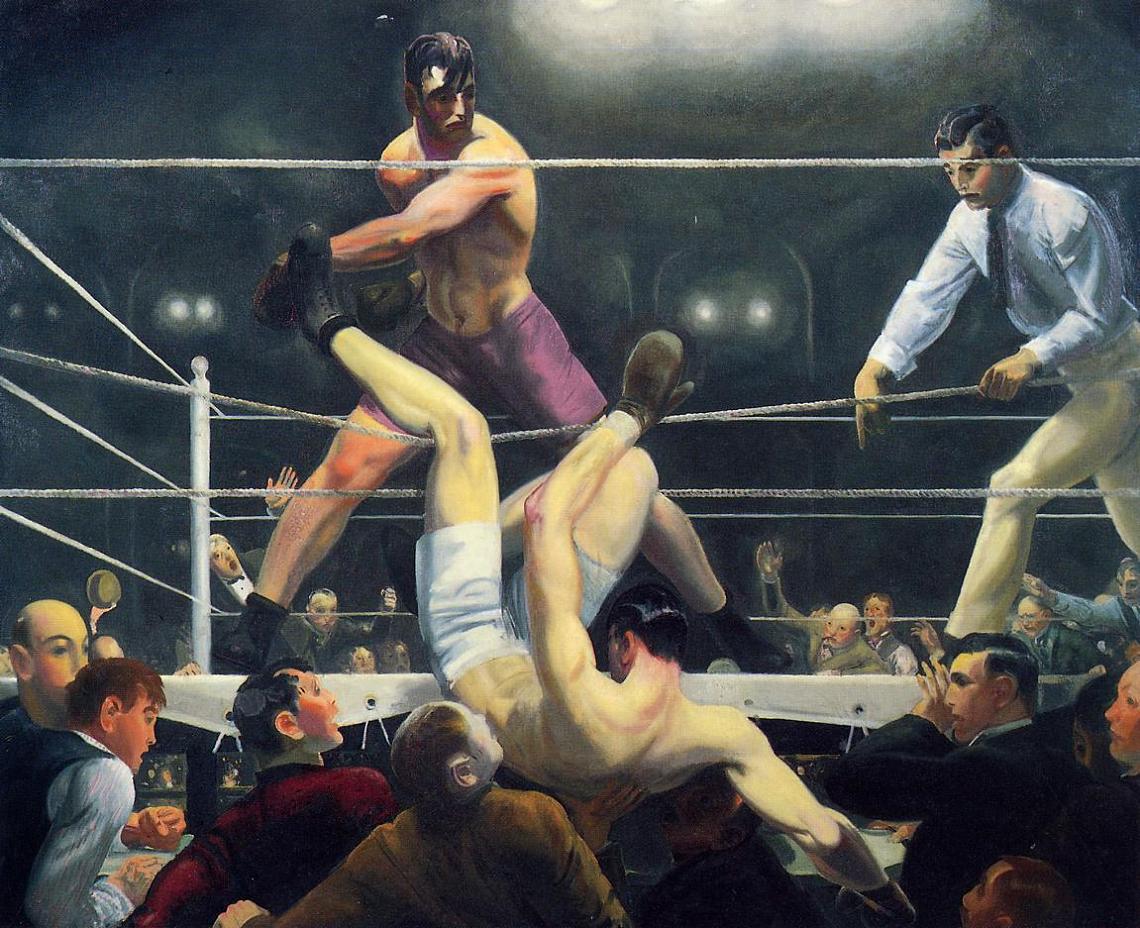
| Jack Dempsey I first 'found' Jack Dempsey when I caught a videotape of him fighting Jess Willard for the World Heavyweight Championship in 1919. Now Willard was the man who took the title in Cuba from the legendary Jack Johnson four years earlier. Willard was heavier (by 60 pounds) and taller (by 5 inches) than Dempsey and despite being 13 years older was overwhelming favourite to win. Seven knockdowns in the first round, a broken jaw, cheekbone, and ribs, as well as losing several teeth wasn't in the script but that is what happened to Willard. It was brutal and brutalising to watch. In those days when someone was knocked down the oppenent didn't have to go to a neutral corner. So there you have Willard on the floor by the ropes and Dempsey towering over him just waiting for any semblance of life before beginning the onslaught again. It was an execution rather than a fight. How brutal? Well it made Hagler-Hearns and Benn-McClellan seem genteel in comparison. So that was my welcome into the world of the Manassa Mauler, the All-American hero. But then Dempsey would never have claimed to be squeaky clean. Though the controvesy surrounding what he had in his gloves to make them harder in the Willard fight is highly probable to be untrue, he did anything to win. When he hit Jack Sharkey unconscious while Sharkey was complaining to the referee about Dempsey hitting him below the belt he came up with this famous line: "What was I supposed to do -- write him a letter?" Funny but it was dirty and there is no getting round the fact that Dempsey was a dirty fighter. But who can blame him? As tough an upbringing as you can imagine, loss of siblings in tragic circumstances, he just had to do anything to win. And I'm sure that it is this coupled with his American good looks that made him popular with the public. And he was immensely popular. Part of the first million dollar fight and all that. With Babe Ruth he has to be the most popular sportman in American history. He filled newspapers of the time - it is hard to convey just how popular he was. He epitomised the roaring '20s. I can't say that I warmed to Dempsey in the way I warmed to Max Schmeling or Joe Louis or even Gene Tunney who beat him twice including The Long Count fight which credit to Dempsey he never complained about. I don't think it is anything to do with him as everything you read about him suggests he was likeable and charismatic. No, I think it is because of how I first came to know of Dempsey and the no-neutral corner business. It just seems plain wrong especially from this distance of time. Seeing it I can only admire Willard's courage for continuing until the fourth round. Such incredible courage in the circumstances. Outside the ring there was talk of him being a slacker (though he later cleared his name). He was married four times. Real name: William Harrison Dempsey Boxing record A BRIEF HISTORY OF A LEGEND: Heavyweight Champion of the World from 1919 to 1926, Jack Dempsey, also known as the Manassa Mauler, began his boxing career as a skinny boy of sixteen, riding the rails and participating in hastily staged saloon bouts against miners and lumberjacks. He is widely regarded as one of the toughest ever to enter the ring. His transition from bar-room fights to professional boxing and his emerging reputation for fast, brutal knockouts is truly remarkable. Dempsey's rise to the heavyweight championship is probaly the reason boxing moved from the fringes of acceptability and into the mainstream. In all he made six title defenses. The eventual loss of his title to Gene Tunney in 1926, and the rematch in 1927, which Dempsey also lost in the infamous "long count", and which he accepted with good grace, are probaly what, in boxing terms, he is most well known for today. Short of money (in no small part to a divorce) he continued to fight in exhibitions. He retired from boxing in 1940 with an astonishing 64 victories, 49 of them knockouts. Like Louis/Schmeling a generation after he became good friends with Tunney when their careers ended. He even campaigned for Tunney's son John V. Tunney when he ran for the U.S. Senate. When Joe Louis fell on hard financial times, Dempsey served as honorary chairman of a fund to assist him. And of course he opened the iconic Jack Dempsey's (Jack Dempsey's Broadway Restaurant to give it its full title) in 1935 and which was open for business for nearly 40 years. In short, he became a pillar of American society. His fame continued long after his death in 1983. The street where Madison Square Garden is located is called Jack Dempsey Corner. Now that is fame. Paul Page, Dec. 2012 MORE: His first wife was a prostitute before and after their marriage. She it was who alleged he was a slacker. He had ten brothers and sisters. At one time he shared an apartment with Charlie Chaplin and Douglas Fairbanks Sr. He described that he had 'the best time of his life'. He refused to watch the Ali-Liston fight live as he knew something not right was going to happen. Jack "Doc" Kearns was his most famous manager. He built up his reputation in the press. Together with the famous promoter Tex Rickard they grossed US$ 8.4 million in only five fights between 1921 and 1927. Included in that is the Georges Carpentier fight in 1921 which Dempsey won in the fourth round. He had a nose job on the advice of his wife at the time, the actress Estelle Taylor. "Honey, I forgot to duck" is his famous line to his wife after his first loss to Tunney. Endeared him to the American public in a way nothing else could do. The fight attracted 120,000 fans. Al Capone had a $45,000 bet on Dempsey to win the 2nd fight against Tunney. The referee had to be changed on the morning on the fight for fear Capone had got at him. Dempsey wanted and had no part in Capone's antics. He was a multi-millionaire (he'd invested in property amongst other things) by the time the stock market crashed in 1929. In one day he lost $3million. He was left with nothing. He did refereeing, mining and exhibition fights until he was up on his feet again. FURTHER READING: These prints are available at:Print Available at: ebay.com How To Fight Tough By Jack Dempsey At the outset of World War II, boxing heavyweight champion Jack Dempsey was appointed as a lieutenant in the U.S. Coast Guard and given the job of director of physical fitness. His orders: "Make 'em tough!" His task: to teach rookie Coast Guardsmen how to fight down and dirty in the face of the very real threat of enemy troops infiltrating American shores. Get in the ring with "the Manassa Mauler" as he gives 18 fully illustrated lessons in the art of bashing and brawling on the battlefield, including Subduing an Armed Enemy, The Unbreakable Strangle, Beating the Punch, Hammering Your Way Out of a Stranglehold, The Belt Trick, Fooling the Smart Knife Man, Turning the Tables with a Bayonet and Breaking a Standoff. All students of nasty close-quarters combat in the tradition of Sykes, Fairbairn, Applegate and other giants of the World War II era will thoroughly enjoy this fascinating piece of CQB history. |