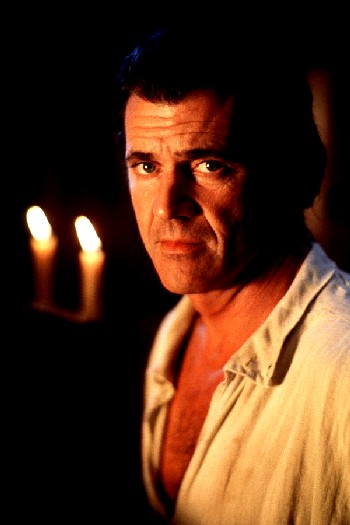
Gibson wouldn't become internationally famous, however, until after his performance in Mad Max 2 (1981), one of the few sequels to have proved superior to its predecessor.
In 1983, Gibson collaborated with director Peter Weir for the second time (though it was largely overlooked during the success of Mad Max 2, Gibson starred in Weir's powerful WWI drama Gallipoli in 1981) for The Year of Living Dangerously, in which he played a callous reporter responsible for covering a bloody Indonesian coup. Shortly afterwards, Gibson made his Hollywood debut in The Bounty with Oscar-winner Anthony Hopkin's, and starred opposite Sissy Spacek in The River during the same year. He would also star in Mad Max Beyond Thunderdome (1985) alongside singer Tina Turner.
After the third installment to the Mad Max franchise, Gibson took a two-year break, only to reappear opposite Danny Glover in director Richard Donner's smash hit Lethal Weapon. The role featured Gibson as Martin Riggs, a volatile police officer reeling from the death of his wife, and cemented a spot as one of Hollywood's premier action stars. Rather than letting himself become typecast, however, Gibson would surprise critics and audiences alike when he accepted the title role in Franco Zeffirelli's Hamlet (1990). Though his performance earned mixed reviews, he was applauded for taking on such a famously tragic script.
In the early 90's, Gibson founded ICON Productions, and through it made his directorial debut in 1993's The Man Without A Face. The film, which also starred Gibson as a horrifically burned teacher harboring a secret, achieved only middling box-office success, though it was considered a well-wrought effort for a first-time director. Gibson would fare much better in 1994, when he rejoined Richard Donner in the movie adaptation of Maverick. However, it would be another year before Gibson's penchant for acting, directing, and producing was given its due - in 1995, Gibson swept the Oscars with Braveheart, his epic account of 13th century Scottish leader William Wallace's lifelong struggle to forge an independent nation. Later that year, he lent his vocal talents - surprising many with his ability to carry a tune -- for the part of John Smith in Disney's animated feature Pocahontas.
Through the 1990s, Gibson's popularity and reputation continued to grow, thanks to such films as Ransom (1996) and Conspiracy Theory (1997). In 1998, Gibson further increased this popularity with the success of two films, Lethal Weapon 4 and Payback.
More success followed in 2000, due to the actor's lead role as an animated rooster in Nick Park and Peter Lord's hugely acclaimed Chicken Run, and to his work as the titular hero of Roland Emmerich's blockbuster period epic The Patriot (2000). After taking up arms in the battlefield of a more modern era in the Vietman drama We Were Soldiers in 2002, Gibson would step in front of the cameras once more for Sixth Sense director M. Night Shyamalan's dramatic sci-fi thriller Signs (also 2002). The film starred Gibson as a grieving patriarch whose rural existence was even further disturbed by the discovery of several crop circles on his property.
Gibson would return to more familiar territory in Randall Wallace's We Were Soldiers; a 2002 war drama which found Gibson in the role of Lt. Col. Hal Moore, commander of the First Battalion, Seventh Cavalry -- the same regiment so fatefully led by George Armstrong Custer.
In 2003, Gibson starred alongside Robert Downey Jr. and Robin Wright-Penn in a remake of The Singing Detective.
2004 saw Gibson return to the director's chair for The Passion of the Christ. Funded by 25 million of Gibson's own dollars, the religious drama generated controversy amid cries of anti-semitism. Despite the debates surrounding the film -- and the fact that all of the dialogue was spoken in Latin and Aramaic -- it nearly recouped its budget in the first day of release.
On a personal note I await Gibson's directorial films these days with far more relish than his acting roles. Nothing against his movie roles - he's a fine actor and up there with the best of his generation. But his directing is something else and the 2006 Apocalypto is the best film I have seen in the last 10 years or so. The chase is up there with the Butch Cassidy one and I can give it no finer compliment. Truly frightening. If you havn't seen it then I strongly recommend getting it now, either at amazon.co.uk or the US equivalent, amazon.com
 . On Blu-ray
 it looks simply stunning.
Ok, his directing can be heavy-handed at times (why crack an egg when you can sledgehammer it) but boy no-one can deny his films are powerful.