
ingrid bergman
(1915-1982)
biography
filmography
gallery
trivia
other galleriesbooks
dvds
posters
videos
autumn sonata
casablanca
notorious
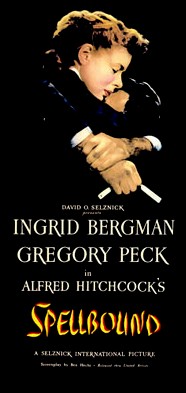
spellbound
under capricorn
ingmar bergman
humphrey bogart
gary cooper
michael curtiz
cary grant
alfred hitchcock
greta garbo
ava gardner
jean harlow
carole lombard
marilyn monroe
spencer tracy
alfred hitchcock
madeleine carroll
greer garson
victor saville
humphrey bogart
paul newman
james stewart
charlie chaplin
fritz lang
f.w. murnau
erich von stroheim
robert wiene
richard attenborough
richard burton
john gielgudstewart granger
cary grant
jack hawkins
stanley holloway
trevor howard
james mason
john mills
david niven
laurence olivier
eric portman
dennis price
richard todd
peter ustinov
isabelle adjani
ursula andress
f. barber
bardot
emmanuelle beart
j. bisset
julie christie
dalle
josette day
britt ekland
garbo
rita hayworth
valerie hobson
margaret lockwood
m. sologne
- ingrid
bergman
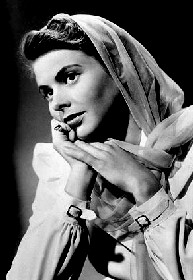
"I've gone from saint to whore and back
[ i n g r i d b e r g m a n : b i o g ]
to saint again, all in one lifetime."
- Ingrid Bergman
biography | casablanca | filmography
gallery | books | dvds | posters | videos
movie rarities in stock
ria bergman - bergmanesque dressmaking in london!
ingrid bergman
ingmar bergman | humphrey bogart | gary cooper
michael curtiz | cary grant | alfred hitchcock
other galleries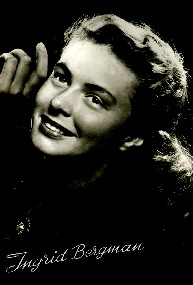
July 2013: new Ingrid Bergman trivia section with all the facts you will ever need on Ingrid Born in Stockholm, Sweden, on August 29, 1915, Ingrid Bergman was brought up by herelderly uncle after the death of her parents, andat 17 joined Stockholm's Royal School ofDramatic Art where she was soon being chosenfor the major roles. In 1933, she signed acontract with the Svenskfilmindustri and madeher first screen appearance in Mimkbrogrevcfi (1935, The Count of the Monk's Bridge). By herfifth film, Pa Solsidan (1936, On the Sunny Side).she had become a star in Sweden. On this andseveral other occasions she worked under thedirection of Gustaf Molander, who managed tobring out the full range of her talents. However, after only a couple more roles as apure and loyal woman, Bergman rebelled.Conscious of her potential, she refused to betypecast and fought for the part of Ivy, thebarmaid of easy virtue, in Victor Fleming's DrJekyll and Mr Hyde (1941). On the other hand For Whom the Bell Tolls (1943), Spellbound, The Bells of St Mary's (both1945) and Joan of Arc (1948) - all roles in whichshe was taking a stand - summarize thepositive aspect of the Bergman character. Theyhighlight her idealism, her sincerity and altruism, all of which Selznick had been sensitiveto. And yet the ambiguous Bergman characters are preferable to her rather 'toneless' andangelic presentations. In Casablanca (1942),the pull of two men, Rick Blaine (HumphreyBogart) and Victor Laszlo (Paul Henreid),unearths a shaky division of loyalties - on theone hand there is her husband and on theother her commitment to the past. The man who had finally persuaded her tomake the break from Selznick was PeterLindstrom, a Swedish dentist to whom Bergman had been married since the beginning ofher career. His intelligent advice in Swedenbecame sadly misguided in Hollywood. Arch ofTriumph (1948) sustained considerable losses.In the same year, Bergman saw RobertoRossellini's Roma, Citta Aperta (Rome, OpenCity) and, greatly impressed, wrote to him offering her services. Curiously, films of the Rossellini period inthe Fifties, in spite of some complex narratives,were not so much a denial of the 'Bergmanmyth' of virginal purity than a change in itsessential qualities. Stromboli (1950, God'sLand), was slightly exceptional in that it stillpartly stemmed from Rossellini's earlier neo-realistic style. Bergman played an unhappywife escaping from the island of the title. However, all her later films in Italy formed alink with her earlier American films. Thetemptations of sainthood in Europa '51 (1951, The Greatest Love) are reminiscent of the religious inspiration of The Bells of St Mary's and Joan of Arc; and the marital hell Stromboli harks back to the tormented wife in Gaslight (1944, The Murder in Thornton Square) - the filmfor which she won her first Academy Award,playing a woman blindly in love with a contemptible adventurer. But the more naturalistic approach of Rossellini was not compatiblewith either actress or theme. In 1950 Bergman finally divorced Lindstrom and married Rossellini, thereby legalizing a relationship that hadcaused a public outcry against her 'scandalous' behaviour and seriously damaged hercareer prospects in Hollywood. But when thestrain of a series of unsuccessful films provedtoo much and Bergman decided to return tothe stage for a while, Rossellini went to make afilm in India and returned with the wife of anIndian director. In 1957, with another divorce,the 'Rossellini period' was over. 20th Century-Fox had offered her thechance of an international comeback with Anastasia in 1956, a story about the escape ofthe Tsar's daughter in 1918. It was a tremendous success, winning Bergman her secondAcademy Award. There followed a series ofroles devised to regain her internationally popular image. In Anastasia, Indiscreet (1958,again teamed with Cary Grant) and Inn of theSixth Happiness (1958, as a missionary inChina), Bergman achieved respectability.Several later films, of which> A Walk in theSpring Rain (1970) - an intimate compositionin halftones, about the affair of a married andmiddle-aged woman - was no exception, werenot suitable material and did not allow her toattain her true potential, but in 1974 she wonanother Academy Award, this for Best Supporting Actress, in Murder on the Orient Express in which she played a timid and devoutmissionary. In 1978, Bergman was cast in AutumnSonata as the self-obsessed mother who istotally involved in her career - the first roleworthy of her since the end of the Selznick period. She bravely exposed herself to Ingmar Bergman's scrutinizing eye and achieved, withhis complicity, a character of great depth andnuance: this was probably one of the mostcomplete, moving and intelligent creations ofthe actress' career. Throughout her years in the cinema, she maintained regular contact with the stage,playing in about ten plays between 1940 and1967, including Joan of Lorraine (1946), for which she was awarded the Tony Award. Teaand Sympathy (1956), Hedda Gabler (1962), and A Month in the Country (1965), directed by SirMichael Redgrave at the Yvonne Arnaudtheatre in Guildford. In 1958 she married atheatrical impresario, Lars Schmidt. >Lordy: imagine seeing Bergman in Guildford, the heart of Surrey countryside. The thought reminds me of a Stanley Spencer painting. It's like seeing a Holy vision in Cookham. She gave an outstanding TV performance in the mini-seriesA Woman Called Golda (1982) (TV), a film about the Israeli prime minister, Golda Meir. For this she won an Emmy Award as Best Actress, but, unfortunately, she didn't live to see the fruits of her labor. Ingrid had died on her birthday, from cancer, on August 29, 1982 in London, England. She was 67. Ingrid Bergman's career spanned a remarkablenumber of years; they divided into four distinctperiods - Sweden, Hollywood, Rossellini andthe International period. She survived thedisappearance of the Hollywood studios andthe Rossellini experience. She also emergedwell from several miscasts, thanks to heradaptability and to a thorough discipline thateven her least interesting roles exhibited. Sheremained a combination of femininity, distance,honour and vulnerability, that still seduces all who see her on screen to this day. All the Ingrid Bergman facts you will need! Trivia has been sourced from the definitive book Ingrid: Ingrid Bergman, a Personal Biography According to Leni Riefenstahl, it was Goebbels who had first recognized the great potential in the young Swedish actress. She said that when Goebbels saw Ingrid Bergman on the set for the first time, he ad a change of mind, and said, 'Too Tall'. Riefenstahl said Madga, Goebbel's wife, was the source for the comment. The urn that had contained the ashes was buried in Norra begravningsplatsen (Northern Cemetery) in Stockholm, next to the graves of her parents. It is surprising to this day that it is recorded that at least some of her ashes are contained there.
biographyDiscovered in Sweden in the earlyThirties, Ingrid Bergman rose to the rank of international star in the Forties, proving herself a brilliantpartner to Bogart, Cooper, Grant and Tracy. For many years the seductions of stardom left her unmoved and she never allowed herself to becomestereotyped. Today, even after a series of uneven films through the later years of her career, her legacy still commands respect and admirationin the industry and to the public alike.

intermezzo
(1939)
Then, in 1939, David 0. Selznick, to whomher growing reputation had been pointed out,brought her to Hollywood and cast her in theremake of Intermezzo: a Love Story, (she hadalready starred in the Swedish version) alongside Leslie Howard. Selznick, a great discovererand modeller of actresses, was aware of theproblems inherent in trying to 'sell' foreignstars to the American public, and astutelydecided to place his bets on a fresh, natural andhealthy image, relying on, in Intermezzo, thesort of story that he knew the public wouldaccept. The gamble paid off and Bergman became an instant success in Hollywood.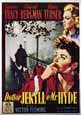
drjekyll and mr hyde
(1941)
This complete role-change, however, served only to 'enrich' her screen image. Many of thesubsequent Bergman heroines were two-facedand their moral irresolution made them fascinating to watch. This was true of SaratogaTrunk (1943), in which she played an illegitimate Creole adventuress in engagingmanner, Notorious (1946), in which she was alady of loose morals but admirable intentions, and Under Capricorn (1949), in which, whileeloping, she murdered her brother who wasfollowing her. These films represent the 'black'aspect of her Hollywood character. Theheroines are thrown into a booby-trapped, nightmarish world and their physical ormental degradation is all the more suggestiveand convincing because the appearance of theactress seems to contradict it. 
casablanca
(1942)
In spite of the diversity of the studios sheworked for and the types of characters sheplayed, Bergman's American career retained acertain unity through the influence of the ever-present Selznick, whose contradictory tastesenabled him to create icy neurotics, fadingmadonnas and nymphomaniacs. After thebreak with Selznick in 1946 something wasdefinitely lost from Bergman's style, andnothing new appeared to take its place.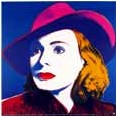
ingrid with hat
(andy warhol)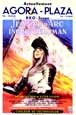
joan of arc
(1948)
autumn sonato
(1978)
trivia

1936 1938 1939 1940 All remaining films USA unless specified 1941 1942 1943 1944 1945 1946 1948 1949 1950 1951 1953 1954 1956 1958 1959 1961 1964 1969 1970 1973 1974 1976 1978 1982
filmography1935
- Munkbrogreven
- Branningar
- Swedenhielms
- Valborgsmassoafton
- Pa Solsidan
- Intermezzo
- Dollar
- Die 4 Geselten
- En Kviinne Ansikte
- En Enda Natt
- Intermezzo: a Love Story
- Juniatten
- Adam Had Four Sons
- Rage in Heaven
- Dr Jekyli and Mr Hyde
- Casablancca
- Swedes in America (short)
- For Whom the BellTolls
- Saratoga Trunk
- Gaslight
- The Bells of StMary's
- Spellbound
- Notorious
- The American Greed (short)
- Arch of Triumph
- Joan of Arc
- Under Capricorn (GB)
- Stromboli
- Terra di Dio(IT)
- Europa '51 (IT)
- Siamo Donne ep II Polio(IT)
- Viaggio in Italia (IT-FR)
- Giovannnad'Arco al Rogo (IT-FR)
- Angst (GER-FR)
- Elena et les Hommes (FR-IT)
- Anastasia (GB)
- Indiscreet(GB)
- The Inn of the Sixth Happiness (GB)
- The Camp (narr. only) (short)
- GoodbyeAgain (USA-FR)
- Der Besuch (GER-FR-IT)
- The Yellow Rolls-Royce (GB)
- Stimulantia ep Smycket (SW)
- Cactus Flower
- A Walk in the Spring Rain
- HenriLanglois/Langlois (guest) (doc) (FR)
- The Hideaways
- Murder on the OrientExpress (GB)
- A Matter of Time (USA-IT)
- Autumn Sonata
- A Woman Called Golda (TV)
biography | casablanca | filmography
gallery | books | dvds | posters | videos
movie rarities in stock
ingrid bergman
ingmar bergman | humphrey bogart | gary cooper
michael curtiz | cary grant | alfred hitchcock
other galleries

Page created by: ihuppert5@aol.com
Changes last made: 2020

