3rd Man Movie :: Trivia
Trivia >> Cast & Crew >> Making >> Plot >> Mini Photo-Stills >>The 3rd Man Film Poster Gallery >>Carol Reed >> Graham Greene >> Trevor Howard >> Alexander Korda >> Alida Valli >> Orson Welles >> British Dvd War Collection >> Advertise >> 3rd Man Dvds available @ amazon.com
All The Facts & Trivia

Search Site >> Carol Reed autographs, photographs and more @ ebay.co.uk (direct link to photographs) - just checked and a bigger selection than i have seen everywhere else
Graham Greene spent two weeks scouting round the city of Vienna for ideas. He was shown the large web of underground sewers andheard tales of racketeering in stolen penicillin that made his hair standon end. Gradually the story took shape, but it was a far cry from thesatirical jollities of the director Carol Reed's Night Train to Munich.
It followed the experiences of an American writer of cowboy novelscalled Holly Martins, who travels to Europe at the invitation of his oldchum Harry Lime. When Martins arrives he discovers that Lime hasbeen killed. Attending the funeral, he is approached by a British Armyofficer, Galloway, who shocks an already dazed Martins by telling himthat Lime was a ruthless racketeer who deserved to die.
Martins does not believe him and decides to remain in Vienna toprove his friend's innocence, but the deeper he digs the more he realizes that Galloway has told the truth - Lime was a drug trafficker. Ofcourse, he isn't dead. Someone else's body occupies his coffin, andit's a simple guess who put it there. But it is not the trade itself whichturns Martins against him, it is the human tragedies that result from Lime's cynical dilution of the drugs. Martins agrees to help Calloway,and the climax is played out in the cavernous sewer tunnels beneaththe city, with Lime trapped and urging Martins to finish him off, whichhe does.
By midsummer 1948 the script was ready, and Alexander Korda, who hadagreed to produce it, roped in the influential Hollywood producer David O. Selznick to handle the US distribution. The original starswere going to be Gary Grant as Martins and Noel Coward as Lime,but Grant's insistence on too large a fee and Reed's opposition to Coward caused a rethink. Film buffs are grateful that it did. Reed dined in London with Orson Welles, who showed interest in playing Harry Lime but who would not commit himself. He was halfwaythrough making Othello but had run into serious financial problems. Welles spent most of the evening puzzling aloud how he could savehis project. With less than half a promise from Welles, Reed flew toHollywood to consult Selznick and inferred during their conversationthat Welles was sold on the idea. This secured Selznick's agreement.The American mogul also proposed Joseph Cotten to play Martins,and to play Lime's love interest, the central female role in the film,he suggested the Italian actress Alida Valli - both of whom Selznick had under contract. Reed approved his casting choices without amurmur and returned to England in a jubilant mood.

Welles and Cotten were old friends, having worked together in Welles's Mercury Theater Company before the war. It was Welles whobrought Cotten to Hollywood to co-star with him in Citizen Kane (1941)and The Magnificent Ambersons (1946). Cotten and Welles created electricity together on the screen, but Selznick, who knew both men well,had hinted to Reed that they might prove to be a handful; he thoughtthey might misbehave and make up their own dialogue. But Reed wasa contented man as he made the return flight to London. Not onlyhad he the best actor that he could think of to play Martins, he sensedthat Cotten was the perfect bait to finally land Welles, and this provedto be the case.
There was a huge sense of anticipation among the cast and crew onthe day Welles was scheduled to arrive in Vienna. He was a big man inevery sense of the word-independent-minded, multi-talented, buoyant, bullish and a great story-teller. It was inevitably Welles's film,although his entrance is delayed until an hour into the action. Thathour supplied him with a magnificent build-up - the other charactersspend most of it talking about him. His presence is everywhere, longbefore that first, tantalizing glimpse of him standing in a doorway atnight, lit only long enough for us to see the mocking grin; and, afterall the speculation and the background music hinting at a shock tocome, finally there he is, smug and sleek, well fed, immaculatelydressed in the deserted streets of starving Vienna. It is a dazzlingmoment which, no matter how often you see the film, never loses itspower.
Trevor Howard was Reed's first and only choice to play Calloway, and togive the character additional gravitas, to make him look more like ahigh-ranking officer, it was suggested that he grow a moustache. Thecontrast between Lime, the master criminal who uses charm like ascalpel, and Calloway, his blunt, methodical nemesis, is memorablyachieved by both actors. Even physically their contrasts appear striking - the stocky, swaggering Lime and the hunched, sober Calloway. Howard was in superb form. He lets you see how badly he hates Lime,but the hatred is inside him. On the surface he gives nothing away.That is acting of a high order.
Welles was full of admiration for the largely British crew, declaringthem the best he had known. Selznick's initial fears that he and Cotten might hijack the film, or, at least, play around with parts of it, cameto nothing. The two Americans appeared tamed by the quality of the material, and not once did they query Reed's direction or causetrouble. Welles had a few ideas of his own, but his suggestions weredesigned to improve, not sabotage, the film. Sometimes they wereincorporated, at other times not.
The original concept of the Ferris-wheel sequence, for example,was modified after Welles and Reed got talking. Although some background shots had been undertaken in Vienna, it proved impossible- and would have been highly dangerous -------- to mount a camera outsidethe Ferris-wheel carriage in which Lime warns Martins againstgetting involved with the police. Reed therefore shot the scene inthe studio and back-projected the view the characters would seeduring the ride.

Welles suggested that Lime's cruelty behind his charming mannercould be brought to the surface with a few additional lines ofdialogue. Reed had no objection. Lime worries about the poor children of Vienna being unable to afford to ride on the big wheel, yethe doesn't care that they are dying because of his watered-downdrugs. Against that, his complaint about his indigestion - 'I wish Icould throw off this thing' - seems self-centred and callous. Welles also added a bitterjoke, a swipe at the US Treasury, which rightly orwrongly he blamed for his financial difficulties on Othello. From thecarriage, high in the air, Lime wonders if Martins would object sostrongly if he was to get £20,000 for every person, or 'dot', on theground who stopped breathing - 'Would you really, old man, tell meto keep my money - or would you calculate how many dots you couldhave? Free of income tax, old man. Free of income tax. It's the onlyway to save nowadays.'
Welles requested one further script addition, a piece of dialogueto be spoken by Lime at the end of the ride, as he dons his gloves andstrides off across the fairground. Lime needs Martins on his side. Calloway is gaining ground, but Martins is the key to his survival. Lime can be caught only if Martins deserts him. So at the end of the ride Lime has to make sure they part as friends, even though he has threatened him. The famous 'cuckoo-clock' speech was Welles's inventionto lighten the tension between the two characters. Millions of cinemagoers still joyfully recite the lines from memory.
He thought, however, that for Martins to turn against Lime hewould have to be shown something truly stomach-churning. The trickwas to show it to Martins without showing the audience. The scene where Calloway takes him on a tour of the children's hospital wasadded. The shocked expression on his face, and the matter-of-factdiscarding of yet another teddy bear into a waste basket, subtly conveysthe horror Martins is feeling.
Selznick was unsure about Greene's original ending in which Martins and Anna resolve their differences. He suggested that Anna would never forgive Martins for helping to destroy the man sheloved. Her grief for Lime immediately after his funeral would ruleout any reconciliation. Reed and Greene were persuaded to changethe ending to one in which Anna ignores him after her long walkbetween the poplar trees. This is another scene cherished by moviebuffs.
A few adjustments had to be made to satisfy the censors. Theyobjected to Martins's mercy killing of Lime because only the policewere licensed to have guns. Greene was obliged to give Calloway anadditional line of dialogue - 'If you see him, shoot!' - which authorized Martins to go after him. Welles filmed a few days in Vienna anda few in London. He wore no make-up and looked no different on thescreen from the globe-hopping bon viveur he was in real life.
The script called for Lime to have 'on his face a look of cheerfulrascality'. Welles was born with that look. All that was required of himwas to be himself. Great actor though he was, Welles had no head forbusiness. He was offered the choice of a straight fee of $100,000 cashor 20 per cent of the profits, and he chose the money. It was sufficientto rescue Othello, but it proved to be the worst financial decision of hislife. A percentage of the profits would have netted him a much largersum. But Welles had no time to dwell on past mistakes; he was too busygetting ready for the next one.

Reed made four films with cinematographer Robert Krasker, ofwhich Odd Man Out (1947) and The Third Man are the most visuallystriking. In the latter film, his low-angle shots of Vienna after dark,with its deserted, cobbled streets and bomb-damaged buildings, createan atmosphere of silent menace. The sequences filmed in the sewers,with their huge interconnecting tunnels large enough in places fortube trains to pass through, the cascading water and the white-suitedguards make the place look awesome and futuristic.
Reed described the thinking behind the camerawork:
'I shot mostof the film with a wide-angle lens that distorted the buildings andemphasized the wet cobblestone streets which had to be hosed downconstantly while we were filming. The angle of vision was just to suggestthat something crooked was going on.'
Krasker also repeated the technique he had employed in Brief Encounter and in Odd Man Out of tilting the camera to emphasize peaks of tension.
These images were bold enough, memorable enough and wererepeated often enough to give Reed the status of an auteur. Theybecame his trademark, although he never acknowledged that hehad one. Nevertheless the claustrophobic, expressionist feel of manyof Reed's Krasker-shot night sequences contain a distinctive signature.
The tilted camera, however, irritated some film critics. C.A. Lejeune in the Observer described Reed's 'habit of printing his scenes askew,with floors sloping at a diagonal and close-ups deliriously tilted' as'most distracting'. Even members of his own profession complainedthat he overdid it. William Wyler, a close friend of Reed's, sent him aspirit level, with a note saying, 'Carol, next time you make a picture,just put it on top of the camera, will you?'
Finding the right theme music for The Third Man was not easy,despite Vienna having been home at one time or other to Mozart, Schubert, Beethoven and the Strauss family. Reed felt that these composers were all unsuitable for a modern-day story about narcoticsand betrayal. There are several versions of the tale of how AntonKaras came to be the composer and soloist on the soundtrack. I ammost familiar with Trevor Howard's version, so that is the one I shallretell.

One night Howard and a friend - he didn't say who - went for aquiet drink in a tiny beer-and-sausage cafe in Sievering, a suburb ofVienna. Anton Karas was strumming the zither, but nobody took anynotice of him. The music could scarcely be heard above the chatter ofthe customers, but, as the night wore on and people started leaving,the zither-playing caught Howard's attention. He loved jazz and thefolk music of many countries and was quite taken with the excitingsounds that Karas was creating.
Several nights later he took Reed to the cafe. The director also likedthe music, but Karas spoke no English and could not understand thecompliments of the two Britons as they left the place at aroundmidnight. Reed had noticed that, as well as sounding soft and romantic and mournful, the zither could produce harsh and vibrant sounds,like the contrasting moods of his film. He revisited the cafe with an interpreter and was told that Karas composed many tunes, some withsimple melody lines for playing to customers, others more complicated for his own amusement. Karas agreed to record some of themon a reel-to-reel tape machine that Reed set up in the bedroom of hishotel.
One of them was a piece that Karas had not played for about fifteenyears because it was quite complicated. Karas explained, through theinterpreter:
'This tune takes a lot out of my fingers. In the cafe nobodybothers to listen. They like easy tunes, the sort one can hear while atthe same time eat sausages.'
Reed brought the tape to London andplayed it to Korda, who was impressed by Karas's musicianship. Reed returned the following day to Vienna and invited him to compose andplay the score for the film. A recording of the segment played behindthe opening credits, called the Harry Lime Theme, was to become apopular hit all over the world.
At the time of its release (in August 1949 in Britain and the following February in the United States) The Third Man attracted mixedreviews. With some critics it struck an immediate chord. Quentin Crisp described it as 'the only good picture ever to come out of Britain'. A.E. Wilson wrote, 'I am inclined to use the word genius sparingly,but there is no other word that adequately suggests the power, the thrill, the mystery and the suspense.' Time magazine deemed it 'thework of a craftsman so skilled that he [Reed] has earned the right tobe judged as an artist'. The New York Daily News called it 'enthralling... with the quality of a symphonic movement'. The respected American critic Bosley Crowther viewed it as 'essentially a first-ratecontrivance in the way of melodrama and that's all ... It doesn'tpresent any message. It hasn't a point of view. It is just a bang-upmelodrama designed to excite and entertain.' Cyril Ray was amongthe least impressed. He wrote, 'There is little in the story that wouldseem to matter. Whether it was all worth doing with so much care andtalent and wit can only be a minority's murmured query.' Yet, likegood wine and violins, and possibly zithers, The Third Man hasimproved with age. Today we are less likely to notice flaws or share Dilys Powell's 'disappointment'. We feast our senses instead on thenear-perfect performances, particularly from Welles and Howard, thefluent black-and-white photography, the unusual score and thecompelling narrative, and not for the first time are we driven to ignorethe carping critics.
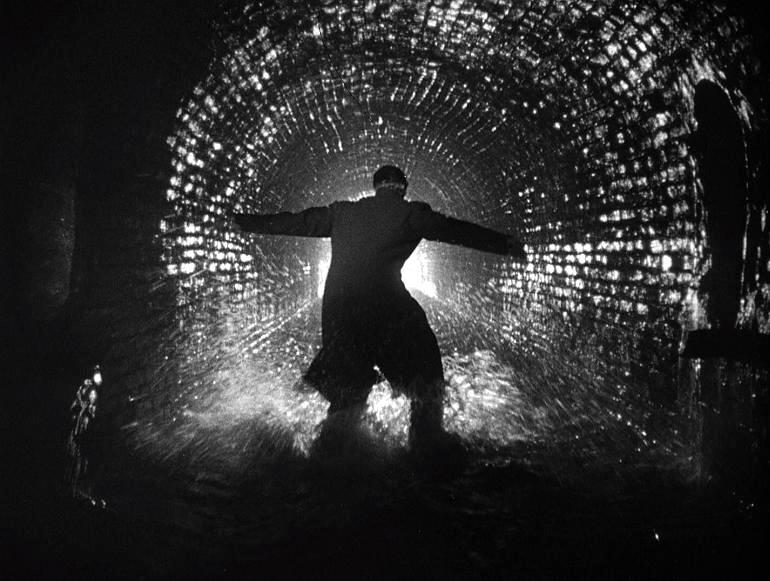
Orson Welles reportedly told Reed, 'Carol, I can't work in a sewer, I'm from California,' and asked for a studio replica of Vienna's sewers to be built in England.
Because Welles would often disappear from the set to work on another project, Othello, and left before the sewer sequence was finished, assistant director Guy Hamilton stood in for him in many of the shadowy sewer scenes.
And in the shot of Harry Lime reaching for the sewer grating, the hands are, in fact, those of director Carol Reed.
On Friday 5th August 2005, viewers of BBC's Newsnight Review voted the film their 4th most favourite of all time. It was the only film in the top five list that was made before 1970.
Official 3rd Man 2 Dvd Set at amazon.co.uk
Links
Trivia >> Cast & Crew >> Making >> Plot >> Mini Photo-Stills >>The 3rd Man Film Poster Gallery >>Carol Reed >> Graham Greene >> Trevor Howard >> Alexander Korda >> Alida Valli >> Orson Welles >> British Dvd War Collection >> Advertise >> 3rd Man Dvds available @ amazon.com
Top of Page >> Search Site >> Search Site >> Carol Reed autographs, photographs and more @ ebay.co.uk (direct link to photographs) - just checked and a bigger selection than i have seen everywhere else

