HECTOR ZAZOU
Links
Hector Zazou Fascinating Facts
Yukihiro Takahashi Fascinating Facts
Haruomi Hosono Fascinating Facts
Ryuichi Sakamoto Fascinating Facts
Roxy Music / Bryan Ferry Fascinating Facts
Scott Walker Fascinating Facts
Michael Brook Fascinating Facts
Penguin Cafe Orchestra Fascinating Facts
David Bowie Rarities (Shipped From UK)
Cocteau Twins Fascinating Facts
Hector Zazou Fascinating Facts
Frank Auerbach Fascinating Facts
Hector Zazou
Artist
Hector Zazou
Content
All the fascinating facts
More
Bitesized
Year
1960s to Present Day
Random and bite-sized facts on all things from the mythical figure that was Hector Zazou. Totally random but totally fascinating if you're into it. Do you know Hector Zazou now?
--
--
Hector Zazou
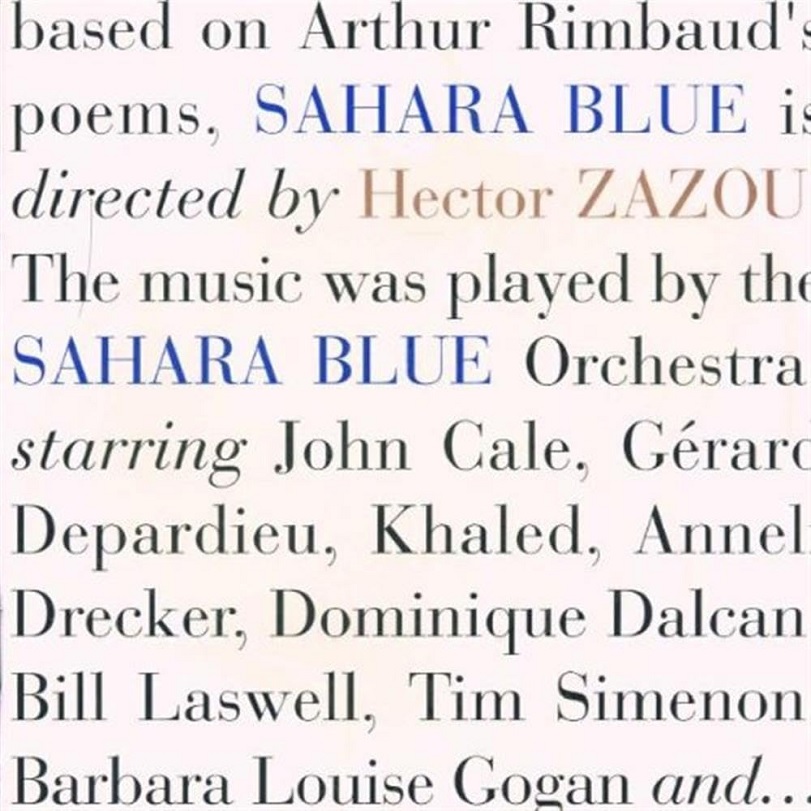
Hector Zazou's 1992 album Sahara Blue, a tribute to poet Arthur Rimbaud, brought together an extraordinary cast: David Sylvian, Ryuichi Sakamoto, John Cale, Bill Laswell, Khaled, and Gérard Depardieu. His follow-up, Songs from the Cold Seas, inspired by Barry Lopez's book Arctic Dreams, gathered Björk, Siouxsie Sioux, Suzanne Vega, and Jane Siberry alongside genuine field recordings of Ainu, Inuit, and Yakut singers. 🎹🌍
--
Hector Zazou
Born in French Algeria, Zazou studied electronic music under Pierre Schaeffer at the Conservatory of Marseilles — the same pioneering figure who indirectly influenced Jean-Michel Jarre's own path. His 1998 album Lights in the Dark brought together Sakamoto once more alongside Peter Gabriel and Brendan Perry of Dead Can Dance. He died in 2008; his posthumous final album was recorded with classical musicians from India and Uzbekistan. 🎹🇩🇿
--
Hector Zazou
Born Pierre Job, Zazou adopted his stage name upon forming ZNR with Joseph Racaille — their 1976 debut, Barricade 3, was placed "under the dual sign of Erik Satie & Captain Beefheart." He also worked for years as a journalist under his real name for French newspapers and magazines, alongside his music career. 📰🎹
--
Hector Zazou
Zazou's 1991 album Les Nouvelles Polyphonies Corses — pairing traditional Corsican a cappella singing with Jon Hassell, John Cale, Ryuichi Sakamoto, and Manu Dibango — won France's own equivalent of the Grammys, the Victoires de la Musique, in 1992. As French journalist Jean-François Bizot once put it: "The English have Peter Gabriel, the Americans David Byrne, the French have Hector Zazou." 🇫🇷🎹
--
SAHARA BLUE — AND THE WORLD OF HECTOR ZAZOU
--
Hector Zazou was one of those musicians who seemed to treat music less as a collection of genres than as a collection of possibilities. His records brought together musicians who might otherwise never have appeared on the same project, placing voices, electronics, traditional music, ambient textures and experimental production alongside one another.
--
His most famous example is probably Sahara Blue, the 1992 album built around the poetry of Arthur Rimbaud. But even that description doesn't really explain how unusual the project was.
--
SAHARA BLUE — ARTHUR RIMBAUD
--
The story began with Jacques Pasquier, who asked Zazou to create music for a 24-hour event marking the centenary of Arthur Rimbaud's death at Paris's Grande Halle de La Villette in 1991.
--
Zazou's original idea was already ambitious. He suggested a collaboration involving himself, Ryuichi Sakamoto, David Sylvian and Laurie Anderson. Anderson ultimately did not take part, but the project developed into the record that became Sahara Blue.
--
Other musicians were gradually added as money became available, turning the project into a remarkably international cast that included John Cale, Ryuichi Sakamoto, David Sylvian, Gérard Depardieu, Bill Laswell, Khaled, Tim Simenon, Brendan Perry and Lisa Gerrard.
--
It wasn't really a conventional "tribute album" to Rimbaud. Zazou was using Rimbaud's writing as the starting point for a much larger experiment in sound.
--
THE DAVID SYLVIAN MYSTERY
--
One of the strangest chapters in the story concerns David Sylvian.
--
The original edition of Sahara Blue contained two tracks featuring Sylvian on lead vocals: To A Reason and Victim Of Stars.
--
They didn't stay there for long. The original pressing was replaced, and the two Sylvian vocal tracks disappeared. They were replaced by Youth, featuring Lisa Gerrard and Brendan Perry of Dead Can Dance, and Black Stream.
--
This makes the first edition of Sahara Blue particularly interesting to collectors. The two Sylvian vocal performances survive on that early pressing, while the much more common later edition contains different tracks.
--
Zazou later gave his own account of what happened. In the booklet to Strong Currents, he said Sylvian did not want the songs he had sung included on the final version. Zazou also said that Sylvian never explained his reasons to him and that the episode had hurt him at the time.
--
Whatever the precise reasons, the result is fascinating: one version of the album effectively contains a different David Sylvian contribution from the version most listeners know. The other reason for Sylvian's withdrawal was his record label, Virgin, refused permission.
SYLVIAN WAS MORE INVOLVED THAN JUST SINGING
--
Sylvian's involvement with Sahara Blue wasn't limited to vocals. The credits also give him guitar and writing contributions on several pieces.
--
On Lettre Au Directeur Des Messageries Maritimes, for example, Sylvian contributed words, final text and guitars.
--
There was also an earlier 1991 CD connected with the Rimbaud project, Parade Sauvage pour Arthur Rimbaud, which preserves versions of material from the developing project, including Sylvian singing A Notre Raison, the French version of To A Reason.
--
RYUICHI SAKAMOTO
--
Ryuichi Sakamoto was another crucial part of the Sahara Blue world. He appears on several tracks, including Ophélie and Hapolot Kenym.
--
The combination of Zazou and Sakamoto is particularly revealing. Both were interested in treating electronic sound as something that could exist alongside traditional and acoustic musical languages rather than simply replacing them.
--
With Zazou, Sakamoto became one colour in an enormous musical palette rather than the centre of the record.
--
DEAD CAN DANCE ENTER THE PICTURE
--
The revised Sahara Blue also produced one of the album's most memorable collaborations: Youth, featuring Lisa Gerrard and Brendan Perry of Dead Can Dance.
--
Their appearance is especially appropriate because Zazou's approach was already concerned with creating atmosphere from voices rather than simply presenting a conventional singer-songwriter performance.
--
Zazou placed Gerrard and Perry inside an electronic and experimental setting that was very different from simply putting a Dead Can Dance song onto somebody else's album.
--
SAHARA BLUE WAS ONLY THE BEGINNING
--
If Sahara Blue introduced Zazou to a much wider audience, his next major collaborative project showed just how far the idea could be taken.
--
Songs From The Cold Seas moved away from Rimbaud and towards traditional songs associated with northern cultures, drawing material from places including Iceland, Greenland, Siberia, Japan and Canada.
--
And once again Zazou assembled an extraordinary cast.
--
Björk appears on Visur Vatnsenda-Rosu. John Cale and Suzanne Vega share The Long Voyage. Siouxsie appears on The Lighthouse. Jane Siberry sings She's Like A Swallow. Tokiko Kato appears on Yaisa Maneena.
--
The album also incorporates singers and musicians from the cultures whose traditional material inspired the project, making it much more than a collection of alternative-rock guest appearances.
--
THE BJÖRK CONNECTION
--
One particularly interesting Zazou connection is with Björk.
--
She recorded Visur Vatnsenda-Rosu for Songs From The Cold Seas, a collaboration involving Zazou, Guy Sigsworth and Renaud Pion.
--
The track is worth hearing in the context of Björk's later work because it shows her voice appearing in an experimental collaborative setting before some of the more familiar electronic landscapes associated with her solo career.
--
JOHN CALE AND SUZANNE VEGA
--
The Long Voyage is another classic example of Zazou's method. John Cale and Suzanne Vega share the performance, with the words drawing on Oscar Wilde's poem The Silhouettes.
--
Cale's presence also creates a strange link between several different generations of experimental music: the Velvet Underground, avant-garde composition, art rock and Zazou's electronic collage approach all meet on one track.
--
SIOUXSIE AND THE COLD SEAS
--
Siouxsie's contribution is The Lighthouse, another example of Zazou choosing a distinctive voice rather than simply looking for conventional vocalists.
--
Her appearance also connects Zazou's world with the post-punk and alternative scene that had developed in Britain during the previous decade.
--
BEFORE SAHARA BLUE
--
Zazou's fascination with unlikely combinations didn't begin in 1992.
--
His earlier work included Noir et Blanc, the 1983 collaboration with Congolese musician Bony Bikaye. The record brought electronic production into direct contact with Bikaye's African musical background.
--
By the time Zazou reached Sahara Blue, the idea of putting apparently unrelated musical worlds together was already central to his work.
--
WHY HECTOR ZAZOU MATTERS
--
Zazou's great talent was not necessarily playing one particular instrument or inventing a single recognisable musical style. It was knowing which musicians, voices and sounds could be placed together to create something that none of them would have produced alone.
--
Rimbaud could lead to Sylvian and Sakamoto. A traditional Arctic song could lead to Björk, John Cale or Siouxsie. African music could meet early electronic experimentation.
--
That makes Hector Zazou's catalogue feel less like a conventional discography and more like a map connecting different corners of experimental music.
--
And Sahara Blue is probably the perfect place to begin exploring it.
--
Search Keywords
Hector Zazou
Sahara Blue
Icon
HECTOR ZAZOU
Links
Hector Zazou Fascinating Facts
Yukihiro Takahashi Fascinating Facts
Haruomi Hosono Fascinating Facts
Ryuichi Sakamoto Fascinating Facts
Roxy Music / Bryan Ferry Fascinating Facts
Scott Walker Fascinating Facts
Michael Brook Fascinating Facts
Penguin Cafe Orchestra Fascinating Facts
David Bowie Rarities (Shipped From UK)
Cocteau Twins Fascinating Facts
Roxy Music / Bryan Ferry Fascinating Facts
Hector Zazou Fascinating Facts
Frank Auerbach Fascinating Facts