JON HASSELL
Links
David Bowie Rarities (Shipped From UK)
Penguin Cafe Orchestra Fascinating Facts
Michael Brook Fascinating Facts
Scott Walker Fascinating Facts
Leonard Cohen Fascinating Facts
Cocteau Twins Fascinating Facts
Roxy Music / Bryan Ferry Fascinating Facts
Ryuichi Sakamoto Fascinating Facts
Haruomi Hosono Fascinating Facts
Yukihiro Takahashi Fascinating Facts
Jon Hassell
Artist
Jon Hassell
Content
All the fascinating facts
More
Bitesized
Year
1970s to Present Day
Random and bite-sized facts on all things from the mythical ambient figure that is Jon Hassell. Totally random but totally fascinating if you're into it. Do you know Jon Hassell now?
--
Jon Hassell approached Farafina as a fellow musician rather than an arranger
When Jon Hassell recorded Flash of the Spirit with Farafina, the eight-piece ensemble from Burkina Faso, he deliberately worked within the group’s musical world rather than treating its playing as material to be reshaped around his trumpet. Percussionist J. A. Deane later recalled spending a month living and rehearsing with the musicians at a château outside Paris, where Hassell’s musical ideas and loops developed through ensemble improvisation. The group then toured Europe and Japan before recording the album in New York in 1987.
--
--
Jon Hassell coined the term “Fourth World” for the music he was developing: a combination of non-Western musical traditions and modern electronic technology.
But the idea came partly from his trumpet. After studying Indian classical music with Pandit Pran Nath, Hassell adapted Pran Nath's vocal techniques to the trumpet, producing a sound that could seem almost like a human voice.
He later described this as the foundation of his best work.
--
Jon Hassell's trumpet sound was partly inspired by Indian singing.
In the 1970s he studied with Pandit Pran Nath, whose music was based on subtle vocal curves and tone-bending. Hassell began trying to reproduce those qualities on the trumpet.
The result was a trumpet that could sound less like a conventional brass instrument and more like a voice.
--
Jon Hassell's Dream Theory in Malaya began with a strange musical experiment.
He invented a scale designed to imitate Indonesian-style tuning and played it against a drone of sine tones.
He then took a short recording of music made by the Semelai people of Malaysia — including water splashing and children's voices — and built his composition “Malay” around fragments of it.
--
Jon Hassell's first album, Vernal Equinox, appeared in 1977 — and it already contained the sound that would become his signature.
He combined Indian-influenced melodic lines with an electronically treated trumpet, years before “world music” became a standard marketing category.
Hassell later regarded the album as the beginning of his Fourth World approach.
--
Jon Hassell and La Monte Young travelled to India in 1972 to study with Pandit Pran Nath.
Hassell wasn't simply studying Indian music academically. He became fascinated by the way Pran Nath's singing shaped individual notes, and tried to transfer that technique directly to his trumpet.
It became one of the foundations of Hassell's distinctive sound.
--
Jon Hassell's Dream Theory in Malaya was partly inspired by a book about dreams.
He found an essay about the Senoi people of Malaya by anthropologist Kilton Stewart, and became fascinated by the phrase “Dream Theory in Malaya”.
The title stayed with him and eventually became the name of his 1981 album.
--
Brian Eno wasn't just a collaborator on Jon Hassell's Dream Theory in Malaya.
Eno played drums, bowl gongs and bells on the album, while Daniel Lanois handled the mix. Michael Brook played bass and Walter De Maria contributed distant drums.
Hassell produced the record himself.
--
Jon Hassell's Power Spot was recorded at the Lanois brothers' studio in Hamilton, Ontario.
Hassell recalled commuting there from Michael Brook's house, where he would make sketches in Brook's basement studio before driving over to record.
Brian Eno was also around the Lanois studio at the time.
--
Jon Hassell once described his musical ambition as making “music for above and below the waist simultaneously”.
For Hassell, Fourth World wasn't simply a mixture of musical styles. He wanted physical rhythm and sensuality to coexist with intellectual and spiritual ideas.
He described it as “heart and head as the same thing”.
--
Jon Hassell's trumpet on David Sylvian's “Words with the Shaman” was recorded in London in just three days.
Hassell's own diaries place his sessions on 5–7 March 1985.
The result became a three-part suite: “Ancient Evening”, “Incantation” and “Awakening”.
--
“Words with the Shaman” was deliberately left open for Jon Hassell and the other musicians to shape.
David Sylvian said he had sketched the pieces beforehand, but didn't try to pin them down in the studio.
He later edited and rearranged the recordings extensively, particularly working with Holger Czukay's contributions.
--
Jon Hassell wasn't simply playing a conventional trumpet part on “Words with the Shaman”.
His trumpet was treated as another texture in the music, with delay sending echoes of his phrases into the surrounding sound.
The effect could make the trumpet seem almost like a voice answering itself from a distance.
--
“Words with the Shaman” grew out of ideas David Sylvian had begun exploring on Brilliant Trees.
Sylvian described the EP as a collaborative extension of those earlier themes, rather than a completely separate project.
Jon Hassell co-wrote all three parts, while Steve Jansen also received a writing credit on “Awakening”.
--
David Sylvian gave Jon Hassell and Holger Czukay very different creative roles.
Sylvian later described Hassell's approach as rigorous and uncompromising, while Czukay's was the opposite: spontaneous, playful and full of experimentation.
Both approaches ended up inside “Words with the Shaman”.
--
On “Awakening”, Steve Jansen's drums weren't recorded as one complete performance.
David Sylvian said the bass drum, snare and hi-hat were built up separately, piece by piece.
Percy Jones's bass was also assembled from sampled fragments of an improvisation.
The track was constructed rather than simply played.
--
Jon Hassell's approach to “Words with the Shaman” was anything but conventional. David Sylvian said Hassell brought a thoroughness and rigour to the sessions that “didn't allow for compromise” and demanded clarity of purpose.
--
Sylvian contrasted Jon Hassell's working method with Holger Czukay's. He described Hassell as rigorous and precise, while Czukay preferred spontaneous invention — throwing ideas at the canvas to see what stuck.
--
“Words with the Shaman” was originally conceived as one long piece. David Sylvian later said he divided it into three because the work had begun to over-reach itself and sound too much like a grand statement.
--
David Sylvian deliberately left “Words with the Shaman” relatively open in the studio. He said he didn't try to pin things down too much when working with musicians of that calibre, preferring to edit and rearrange the material afterwards.
--
The musicians on “Awakening” weren't simply recorded as a conventional band playing together. Sylvian said Steve Jansen's drums were built up piece by piece, while Percy Jones' bass part was assembled from sampled sections of improvisation.
--
Holger Czukay brought a bag of cassette tapes to the “Words with the Shaman” sessions. He would play them while the track was running, allowing sounds that happened to fall into place to become part of the recording.
--
Jon Hassell played on the very first recording of Terry Riley's In C in 1968. Hassell was part of the experimental New York scene around Riley and La Monte Young before developing his own Fourth World music.
--
Before developing his distinctive trumpet style, Jon Hassell studied electronic and serial music with Karlheinz Stockhausen in Cologne. His classmates included musicians who would later form Can.
--
Jon Hassell's first album, Vernal Equinox, appeared in 1977 — but the sound was already remarkably different from conventional trumpet music. His trumpet was electronically treated and combined with Indian raga ideas, African and Brazilian percussion, drones and even recordings of birds.
--
Hassell didn't regard his music as simply a fusion of different national styles. He wanted the individual ingredients to become so integrated that, at any given moment, you couldn't identify one particular country or musical genre as the source.
--
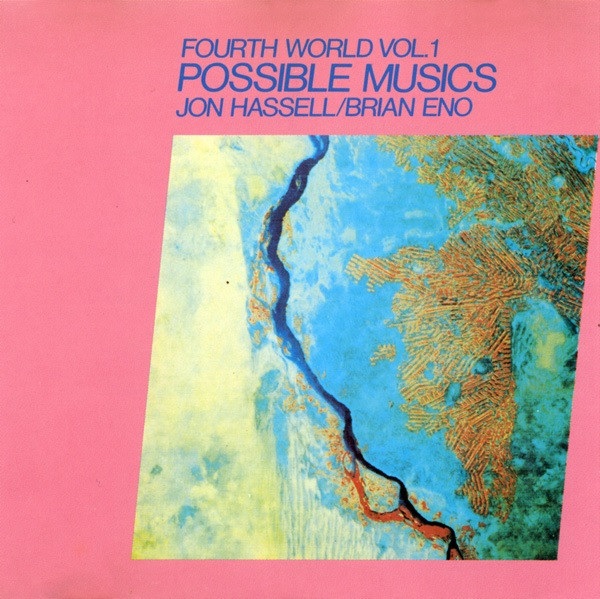
Jon Hassell first met Brian Eno after Eno heard Vernal Equinox in New York. Eno went backstage after one of Hassell's concerts and suggested that they should work together. Their collaboration produced Fourth World Vol. 1: Possible Musics.
--
On “Darbari Extension” from Aka-Dabari-Java, Hassell described his trumpet as being electronically multiplied into a chorus of trumpets. He then placed the Indian raga Darbari over Senegalese drumming and fragments of a 1950s Hollywood orchestration.
--
Jon Hassell once described his musical ambition as making “music for above and below the waist simultaneously”. He also described Fourth World music as being about the head and heart functioning as the same thing.
--
Search Keywords
Jon Hassell
Ambient
Trumpet
JON HASSELL
Links
David Bowie Rarities (Shipped From UK)
Michael Brook Fascinating Facts
Penguin Cafe Orchestra Fascinating Facts
Scott Walker Fascinating Facts
Leonard Cohen Fascinating Facts
Cocteau Twins Fascinating Facts
Roxy Music / Bryan Ferry Fascinating Facts
Ryuichi Sakamoto Fascinating Facts
Haruomi Hosono Fascinating Facts
Yukihiro Takahashi Fascinating Facts