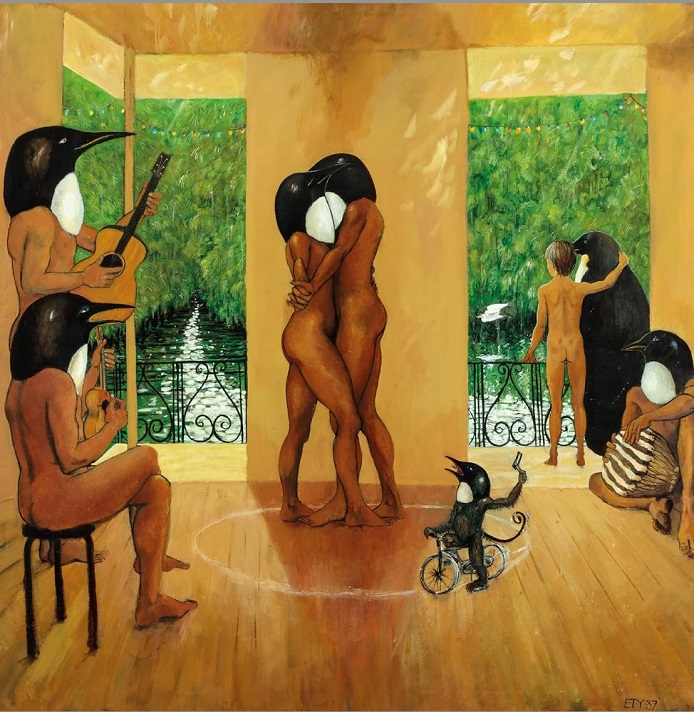
PENGUIN CAFE ORCHESTRA
Links
Penguin Cafe Orchestra Fascinating Facts
Michael Brook Fascinating Facts
Scott Walker Fascinating Facts
Led Zeppelin Fascinating Facts
Human League Fascinating Facts
Leonard Cohen Fascinating Facts
David Bowie Rarities (Shipped From UK)
Cocteau Twins Fascinating Facts
Roxy Music / Bryan Ferry Fascinating Facts
Ryuichi Sakamoto Fascinating Facts
Haruomi Hosono Fascinating Facts
Yukihiro Takahashi Fascinating Facts
Penguin Cafe Orchestra
Artist
Penguin Cafe Orchestra
Content
All the fascinating facts
More
Bitesized
Year
1970s to Present Day
Random and bite-sized facts on all things from the mythical ambient gurus that were the Penguin Cafe Orchestra. Totally random but totally fascinating if you're into it. Do you know the Penguin Cafe Orchestra now?
--
Simon Jeffes came up with the idea for the Penguin Cafe Orchestra while recovering from food poisoning in the south of France in 1972. During a feverish vision, he imagined a Penguin Cafe where a band played music that sounded strangely familiar but impossible to place. When he recovered, he decided to write that music.
--
“Music for a Found Harmonium” really was written on a found harmonium. Simon Jeffes discovered the instrument abandoned on a street in Kyoto while staying in Japan. He left a note asking if he could take it, returned the next day and found it still there. He took it away and wrote the piece on it.
--
The famous “Telephone and Rubber Band” began with a crossed telephone line. Simon Jeffes heard the ringing and engaged tones together, realised they created an interesting rhythmic pattern, then connected the telephone receiver to a tape machine and made a loop from the sounds.
--
The “rubber band” in “Telephone and Rubber Band” wasn't just a metaphor. Simon Jeffes used an actual rubber band attached to a chair, with a pickup, to create the bass-line sound in early versions of the piece.
--
Simon Jeffes had some remarkably unexpected connections to the punk world. He arranged the strings for Sid Vicious's version of “My Way” and taught Burundi drumming to members of Adam and the Ants.
--
The Penguin Cafe Orchestra's first album, Music from the Penguin Cafe, was released in 1976 on Brian Eno's Obscure Records label. Eno was an important early supporter of Jeffes and the group.
--
Simon Jeffes sometimes treated everyday sounds as potential music. Artist Emily Young recalled going with him to Heathrow Airport late at night, where he listened to the hums, knocks and mechanical noises. He imagined the entire airport as one enormous musical instrument.
--
The Penguin Cafe Orchestra even became a ballet. In 1988, the Royal Ballet performed Still Life at the Penguin Cafe, with dancers appearing as animals including zebras and penguins, using music from Simon Jeffes and the Penguin Cafe Orchestra.
--
Before the Penguin Cafe Orchestra existed, Simon Jeffes had already been trying to find somewhere for his music to belong. He said he had worked around avant-garde music, experimental rock, commercial music and ethnic music, but didn't really fit into any of them. His answer was to try integrating those different worlds into one body of music.
--
The first Penguin Cafe Orchestra album was recorded between 1974 and 1976 and released in 1976 on Brian Eno's Obscure Records. Eno was its executive producer, and the album was the seventh release on the label.
--
The original Penguin Cafe Orchestra wasn't a fixed band in the conventional sense. Simon Jeffes and cellist Helen Liebmann were the only permanent members, while the other musicians changed from project to project.
--
The group initially performed under another name. When it began playing in London in 1973, it was known as the Penguin Cafe Quartet before developing into the Penguin Cafe Orchestra.
--
Simon Jeffes wasn't actually a trained violinist, but that didn't stop him using violin on “Telephone and Rubber Band”. His son Arthur recalled that his father simply kept the violin part because it worked.
--
“Telephone and Rubber Band” began with a technical accident. Simon Jeffes heard a telephone ringing and an engaged signal at the same time because of a crossed line. Instead of hanging up, he dismantled the telephone receiver and connected it to a tape machine so he could record the sounds.
--
Simon Jeffes thought of the Penguin Cafe Orchestra less as a conventional band than as music that belonged in a particular place. Brian Eno's Music for Airports was an important influence on him because Jeffes liked the idea of music existing in a space rather than simply functioning as a narrative.
--
The Penguin Cafe Orchestra's music eventually became a ballet. David Bintley approached Simon Jeffes, and Still Life at the Penguin Cafe was first performed by the Royal Ballet at Covent Garden in 1988. Much of the score drew on music Jeffes had already composed between 1981 and 1987.
--
The Penguin Cafe Orchestra's unusual instrumentation wasn't simply a gimmick. Simon Jeffes was fascinated by the way ordinary sounds could interact, sometimes producing unexpected rhythms or even something resembling harmony. Former PCO member Geoffrey Richardson recalled Jeffes listening to sounds such as escalators and air-conditioning hums as potential musical material.
--
Simon Jeffes provided the string arrangement for Sid Vicious's recording of “My Way” in 1978. He also taught Burundi drumming to members of Adam and the Ants — two very different musical worlds that somehow intersected in Jeffes' career.
--
The Penguin Cafe Orchestra's first album did not initially have quite the same artist credit that later became familiar. The original release was credited to Simon Jeffes, while the cover referred to “members of the Penguin Café Orchestra”. Later reissues generally used Penguin Cafe Orchestra as the artist name.
--
After Simon Jeffes died in 1997, the Penguin Cafe Orchestra's musicians continued performing his music for a time under the name The Orchestra That Fell To Earth. The group played memorial concerts in London in 2007, with Jeffes' son Arthur also involved.
--
Steve Nye was involved with the Penguin Cafe Orchestra from its earliest days. He was part of the original Penguin Cafe Quartet, playing electric piano alongside Simon Jeffes, Helen Liebmann and Gavyn Wright.
--
Steve Nye played a crucial role in getting the Penguin Cafe Orchestra onto Brian Eno's Obscure Records. Nye already knew Eno, and in 1975 introduced Eno to Simon Jeffes. Eno subsequently invited the group to record for the label.
--
Nye wasn't simply a musician in the Penguin Cafe Orchestra. He was also an engineer and producer on Music from the Penguin Cafe, helping to record and mix the album as well as playing electric piano.
--
Steve Nye's career crossed an extraordinary range of music. Before becoming known as a producer, he worked as an engineer at AIR Studios, where he worked on recordings by artists including Roxy Music and Stevie Wonder.
--
Nye's connection with David Sylvian went well beyond engineering. Sylvian said he co-produced Brilliant Trees with Nye and had already worked with him on Japan's albums. Sylvian valued Nye particularly for his ability to understand an artist's intentions and interpret them in the studio.
--
Steve Nye remained involved with the Penguin Cafe Orchestra for many years. He played on the group's 1981 album Penguin Cafe Orchestra, as well as later recordings including Signs of Life.
--
Nye was not only an interpreter of Simon Jeffes' compositions. He co-wrote “Paul's Dance” with Jeffes, one of the relatively few Penguin Cafe Orchestra pieces to carry a co-writing credit.
--
The Penguin Cafe Orchestra provided an unusual link between Steve Nye's work as a studio engineer and his work as a musician. On Music from the Penguin Cafe, he was simultaneously part of the playing ensemble and involved behind the recording console.
--
Search Keywords
Penguin Cafe Orchestra
Ambient
Simon Jeffes
PENGUIN CAFE ORCHESTRA
Links
Penguin Cafe Orchestra Fascinating Facts
Human League Fascinating Facts
Michael Brook Fascinating Facts
Led Zeppelin Fascinating Facts
Scott Walker Fascinating Facts
Leonard Cohen Fascinating Facts
David Bowie Rarities (Shipped From UK)
Cocteau Twins Fascinating Facts
Roxy Music / Bryan Ferry Fascinating Facts
Ryuichi Sakamoto Fascinating Facts
Haruomi Hosono Fascinating Facts
Yukihiro Takahashi Fascinating Facts