OMD
Links
Buy
OMD Vinyl - direct link @ ebay.co.uk
(Lenin is a participant in the eBay (EPN) affiliate program)
Siouxsie and the Banshees Fascinating Facts
Led Zeppelin Fascinating Facts
Human League Fascinating Facts
Visage / Steve Strange Fascinating Facts
Tears For Fears Fascinating Facts
Queen / Freddie Mercury Fascinating Facts
Danny Thompson Fascinating Facts
Talking Heads Fascinating Facts
Porcupine Tree Fascinating Facts
Adam and the Ants Fascinating Facts
Queen / Freddie Mercury Fascinating FactsMarc Bolan and T. Rex Fascinating Facts
Sting & The Police Fascinating Facts
Jean-Michel Jarre Fascinating Facts
Peter Gabriel Fascinating Facts
Holger Czukay Fascinating Facts
Anton Corbijn Fascinating Facts
Dexys Midnight Runners Fascinating Facts
Roxy Music / Bryan Ferry Fascinating Facts
Elvis Presley Fascinating Facts
Scott Walker Fascinating Facts
Michael Brook Fascinating Facts
Penguin Cafe Orchestra Fascinating Facts
David Bowie Rarities (Shipped From UK)
Cocteau Twins Fascinating Facts
Ryuichi Sakamoto Fascinating Facts
Haruomi Hosono Fascinating Facts
Yukihiro Takahashi Fascinating Facts
Hector Zazou Fascinating Facts
Frank Auerbach Fascinating Facts
Orchestral Manoeuvres in the Dark (OMD)
Artist
Orchestral Manoeuvres in the Dark (OMD)
Content
All the fascinating facts
More
Bitesized
Year
1970s to Present Day
Random and bite-sized facts on all things on the mythical band OMD. Totally random but totally fascinating if you're into it. Do you know OMD now?
--
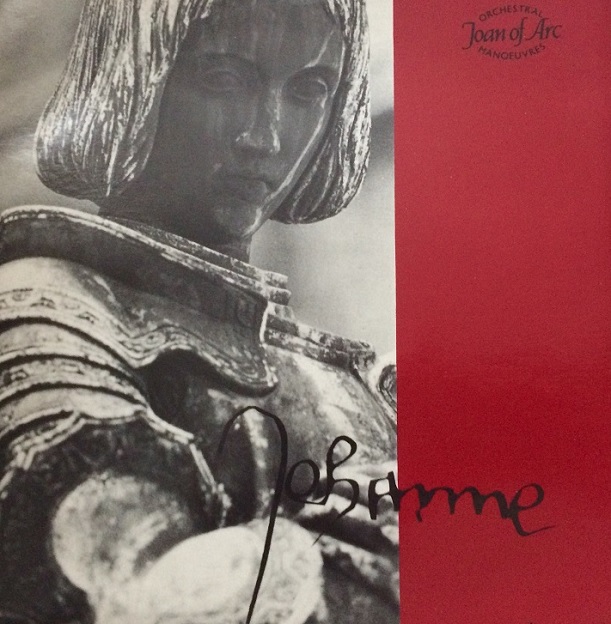
OMD - Joan of Arc 7" Vinyl Single 45 RPM 1981 DinDisc DIN 36
One of my favourite 7"sleeves of the 1980s probally because of the strength of her scroll. I did once see a 'Best Wishes' above it but quickly realised it wasn't Joan as it was in blue marker.
--
OMD only intended to play one concert
When Andy McCluskey and Paul Humphreys formed Orchestral Manoeuvres in the Dark in 1978, they weren't setting out to build a career as a pop band. They had been experimenting with electronic music in Humphreys' mother's back room and wanted to perform their own material as they had written it. The name was chosen for what they expected to be a one-off concert. Instead, the show led to more gigs, a record deal and a career neither musician had planned.
--
The band's name came from ideas on a bedroom wall
Orchestral Manoeuvres in the Dark wasn't chosen after lengthy discussions about how a new band should present itself. Andy McCluskey had a collection of song titles and ideas written on his bedroom wall, and the name emerged from that material. It also helped distinguish the duo from the punk groups around them. Given that they expected to play just one concert, they didn't have much reason to worry about whether the name would still suit them decades later.
--
OMD spent their record advance on building a studio
When OMD received an advance for their debut album, Andy McCluskey and Paul Humphreys decided to invest much of it in recording equipment rather than spend the money hiring studio time. They built their own recording space in Liverpool, which they called the Gramophone Suite. The pair were pessimistic about their chances of lasting beyond the first album, but at least they would have their own studio if the record company dropped them. It was a practical decision that also gave them greater freedom to experiment.
--
A stolen roof covering complicated OMD's first album
The Gramophone Suite wasn't exactly a purpose-built recording facility. The lead covering was stolen from the roof, allowing water to leak into the building. During work on OMD's debut album, Andy McCluskey reportedly had to sing under an umbrella to protect himself from the drips. It's an unlikely image for a group whose music was becoming increasingly associated with synthesizers and futuristic sounds, but their early recording conditions were decidedly makeshift.
--
Paul Humphreys built equipment from salvaged electronics
Before OMD had access to a proper studio, Paul Humphreys was already finding ways to make electronic music with whatever he could get hold of. He experimented with electronic components and built equipment from circuit boards salvaged from radios belonging to his aunt. The duo weren't working with an expensive collection of sophisticated machines; they were learning how to create the sounds they wanted by improvising with limited resources.
--
Andy McCluskey played a left-handed bass upside down
McCluskey's early bass guitar was left-handed, not because he was a left-handed player, but because it was the instrument available when he went looking for one. He was so determined to have it that he played it upside down. It's a small detail from OMD's beginnings, but it captures the resourcefulness of a duo who were more interested in getting their ideas out into the world than waiting for the right equipment to turn up.
--
OMD's experimental side project borrowed its name from Kraftwerk
Before OMD settled on their best-known name, McCluskey and Humphreys experimented under the name VCL XI. The letters came from a label on the back cover of Kraftwerk's 1975 album *Radio-Activity*. The reference reflected how closely the two musicians were studying electronic music, but VCL XI also gave them a space to explore ideas that didn't necessarily fit the conventional rock-band format they had previously worked in.
--
OMD's early live performances included a tape machine called Winston
In their early live shows, OMD were not a conventional band with a full rhythm section. McCluskey and Humphreys used a four-track TEAC tape machine to help reproduce the sounds and arrangements they had created in the studio. The machine acquired the name Winston and became part of the duo's unusual stage setup. For a group working with programmed and recorded sounds before electronic pop had become commonplace, the tape machine was an essential extra member of the act.
--
OMD's debut album included songs from an earlier band
When OMD recorded their 1980 debut album, they weren't starting their songwriting history from scratch. Several tracks had originated during their time in the Id, the Wirral band that McCluskey and Humphreys had played in before OMD. Songs including 'Julia's Song' and 'The Misunderstanding' had already existed in that earlier musical world. The debut therefore captured several years of ideas, rather than simply documenting a new duo's first attempts at writing electronic pop.
--
Andy McCluskey researched the subject of 'Enola Gay' in a library
OMD's 'Enola Gay' was inspired by the aircraft that dropped the atomic bomb on Hiroshima, but Andy McCluskey didn't rely solely on his existing knowledge when writing it. He went to the library to research the subject. The song's bright, catchy melody sits in striking contrast to its historical subject, and the band had reservations about releasing it. Their manager even threatened to resign over the decision to put it out as a single.
--
OMD's first album cover was designed to be physically cut out
The sleeve for OMD's 1980 debut album, designed by Peter Saville and Ben Kelly, used a die-cut design that made the physical record itself part of the artwork. Paul Humphreys later described it as one of his favourite OMD sleeves, praising its simplicity and the way the cut-outs worked on the 12-inch version. At a time when the duo had given little thought to image or presentation, Saville's design helped give their music a distinctive visual identity.
--
OMD
Links
Buy
OMD Japanese Vinyl - direct link @ ebay.co.uk
(Lenin is a participant in the eBay (EPN) affiliate program)
--
OMD’s interest in Joan of Arc began on tour in France
In 1981, OMD toured France and visited towns associated with Joan of Arc. Their French support band jokingly dubbed the trip the “Joan of Arc tour”, planting an idea in Andy McCluskey’s mind. Back home, he began researching her life in books and making notes for a song. What started as a passing remark from another band eventually inspired two of OMD’s best-known recordings.
--
‘Maid of Orleans’ was written before ‘Joan of Arc’
Although ‘Joan of Arc’ appeared first as a single, it wasn't the first of OMD’s two songs about the French heroine to be written. Andy McCluskey initially composed ‘Maid of Orleans’, but felt the waltz-like piece wasn't working and put it aside. He then wrote a different song, ‘Joan of Arc’. The original composition was revived during the recording of *Architecture & Morality* and eventually became the bigger hit.
--
Andy McCluskey wrote ‘Joan of Arc’ on the anniversary of her death
McCluskey wrote ‘Joan of Arc’ on 30 May 1981, the 550th anniversary of Joan’s execution. His interest went beyond simply using a historical name for a pop song: he had been reading about her life and was fascinated by the mystery surrounding her motives, beliefs and reputation. That curiosity became the starting point for a song that approached a medieval figure through the unusual sounds of early-1980s electronic pop.
--
The choir-like sound on ‘Joan of Arc’ is Andy McCluskey’s voice
The haunting vocal sound at the beginning of ‘Joan of Arc’ isn't a choir or a synthesiser preset. McCluskey sang in falsetto and double-tracked his voice to create the unusual effect. He then added glockenspiel sounds around it. The result gives the track an almost ceremonial atmosphere before the electronic rhythm and melody fully emerge.
--
‘Joan of Arc’ was built around the Prophet-5 synthesiser
The distinctive chords on OMD’s ‘Joan of Arc’ came from the Sequential Circuits Prophet-5 synthesiser. The instrument helped give the song its solemn, almost orchestral character without using a conventional string section. OMD were particularly interested in making electronic equipment produce sounds that carried emotion, rather than simply using synthesizers to imitate familiar instruments.
--
OMD released ‘Joan of Arc’ without making a promotional video
‘Joan of Arc’ was released as a single in the UK in October 1981, but the band didn't make a promotional video for it. Andy McCluskey later explained that the UK release was intended to give the market another single while ‘Souvenir’ was still being worked in other European countries. The next single, ‘Maid of Orleans’, would be released more widely in 1982 and become a much bigger international success.
--
The sleeve of ‘Joan of Arc’ features her actual signature
The artwork for the ‘Joan of Arc’ single includes a signature attributed to Joan herself, taken from a letter she signed while imprisoned in 1431. The sleeve also features a statue in front of Orléans city hall. The statue is a copy of a work made by Princess Marie of Orléans in the 1830s. Peter Saville’s design connected OMD’s modern electronic music with an authentic historical artefact.
--
Malcolm Holmes helped give ‘Maid of Orleans’ its military drum sound
The marching rhythm of ‘Maid of Orleans’ was influenced by Andy McCluskey’s interest in military band music, including recordings of the Edinburgh Military Tattoo. During the sessions at The Manor studio, drummer Malcolm Holmes suggested replacing the drum-machine part with real military-style drumming. That contribution helped turn the song into something quite different from the conventional dance beat expected of a synth-pop single.
--
‘Maid of Orleans’ became a bigger hit than OMD expected
Andy McCluskey initially wasn't convinced that ‘Maid of Orleans’ was an obvious single. He had regarded ‘Souvenir’ and ‘Joan of Arc’ as the more immediate choices, and the record company suggested releasing the unusual waltz-like track. It went on to become a major European hit, reaching number one in several countries and helping *Architecture & Morality* reach a much wider audience.
--
‘Maid of Orleans’ was also known as ‘The Waltz of Joan of Arc’
The full single title was ‘Maid of Orleans (The Waltz Joan of Arc)’, distinguishing it from the earlier ‘Joan of Arc’. The subtitle reflected the song’s waltz-like structure and its connection to the same historical figure. The two tracks were not alternative versions of one composition: they were separate songs written from McCluskey’s fascination with Joan of Arc.
--
McCluskey was drawn to the uncertainty surrounding Joan of Arc
McCluskey later explained that he was fascinated by how difficult it was to separate Joan of Arc the historical person from the many competing interpretations of her life. Different groups had turned her into a symbol for their own beliefs, and he was interested in the contradictions and uncertainty. That made her a natural subject for a songwriter who was attracted to unusual characters and the extraordinary things people do when driven by conviction.
--
OMD
Links
Buy
OMD Japanese Vinyl - direct link @ ebay.co.uk
(Lenin is a participant in the eBay (EPN) affiliate program)
--
OMD built their early sound partly because they couldn't afford the equipment they wanted
Andy McCluskey and Paul Humphreys were fascinated by German electronic groups such as Kraftwerk, Neu! and La Düsseldorf, but they couldn't afford the expensive synthesizers they admired. Instead, they worked with inexpensive instruments, borrowed equipment and homemade electronics. Paul Humphreys later explained that this lack of resources helped shape OMD's identity: rather than reproducing the music they loved, they ended up developing a sound of their own.
--
Paul Humphreys experimented with circuit boards taken from old radios
Before OMD had access to a proper collection of synthesizers, Humphreys put his electronics knowledge to practical use. He took circuit boards from old radios and experimented with them to create unusual sounds. He also built some of the duo's early noise-making devices and a drum machine. It was a hands-on approach to electronic music, with Humphreys learning how to make equipment do things its original designers hadn't intended.
--
The Korg Micro-Preset was central to OMD's early sound
One of the most important instruments in OMD's early recordings was the Korg M500 Micro-Preset, a relatively inexpensive synthesizer bought through a mail-order catalogue. It was a far cry from the costly equipment associated with progressive rock keyboard players, but it gave McCluskey and Humphreys a new range of electronic sounds to work with. The instrument became a key part of the sound of their first two albums, including the single 'Electricity'.
--
OMD developed a way of making small synthesizers sound much bigger
The synthesizers OMD used in their early years were often monophonic, meaning they could play only one note at a time. Andy McCluskey later explained that the duo would frequently record the same melodic part several times by hand, slightly detuning the performances to create a wider, richer sound. Rather than relying on a single expensive instrument capable of producing a huge sound, they built up the effect through repeated performances and layers of recording.
--
The tape recorder Winston was effectively another member of OMD
OMD's early live performances relied on a TEAC four-track tape recorder nicknamed Winston. It belonged to their manager, Paul Collister, and allowed the duo to perform music that would otherwise have required more musicians. The machine became such an essential part of their stage setup that it was treated almost like another member of the band. In the late 1970s, when synthesizer-based duos were still unusual, this was a practical way to reproduce their carefully constructed recordings on stage.
--
OMD's early recording studio was more workshop than professional studio
The Gramophone Suite, the Liverpool recording space where OMD made their first album, was a makeshift operation. Drummer Malcolm Holmes later remembered cables everywhere, bits of tape recorder scattered around and electronic drum equipment being assembled in the corner. He described it as more like a garage workshop than a conventional recording studio. That environment suited the duo's experimental approach: it was somewhere to try ideas, build equipment and capture sounds without the expense of hiring a professional studio.
--
OMD were experimenting with electronic music before they settled on their name
Before becoming Orchestral Manoeuvres in the Dark, McCluskey and Humphreys worked together on the experimental project VCL XI. Its name came from a label on the back cover of Kraftwerk's *Radio-Activity*. The project gave them room to explore their interest in electronic sound beyond the conventional band format. They had already been developing these ideas while playing in earlier groups, including The Id, before deciding to pursue their electronic experiments as a duo.
--
OMD's early technology could be frustratingly unreliable
In the early days, McCluskey and Humphreys didn't have the convenience of modern computers, software instruments or dependable digital sequencing. Their equipment could be temperamental, and the sounds produced by their homemade devices weren't always consistent. They had to work with the machines they had, finding ways to capture musical ideas despite their limitations. That combination of experimentation and problem-solving became part of the way OMD developed their music.
--
OMD's approach to electronics was never simply about sounding futuristic
Although Kraftwerk and other German electronic groups were major influences, OMD weren't interested in making music that was cold or mechanical for its own sake. Paul Humphreys has explained that the duo were drawn to the possibilities of electronic instruments but wanted to combine them with strong melodies. Their early recordings brought together repetitive patterns, unusual textures and memorable tunes, helping them turn experimental electronic ideas into concise pop songs.
--
OMD
Links
Buy
OMD Japanese Vinyl - direct link @ ebay.co.uk
(Lenin is a participant in the eBay (EPN) affiliate program)
--
His first musical partnership with Paul Humphreys began when they were children
McCluskey and Humphreys met when they were seven years old, after Humphreys moved from London to the Wirral. They later attended different secondary schools, but music brought them back together. Friends of Humphreys needed a bass player for their band, and they approached McCluskey after seeing him walking around a local park with his bass guitar. That invitation helped set the stage for one of British electronic pop's longest-running partnerships.
--
McCluskey's first great musical revelation was seeing Kraftwerk live
McCluskey saw Kraftwerk perform at Liverpool Empire on 11 September 1975. He later described the concert as a life-changing experience, recalling that some people in the audience walked out because they didn't know what to make of the music. For McCluskey, however, Kraftwerk demonstrated that electronic sounds could be the basis of an entirely new kind of popular music. Their influence would become a defining part of OMD's identity.
--
He was already writing cynical lyrics before OMD had a record deal
McCluskey recalled that 'Pretending to See the Future', which appeared on OMD's debut album, was written around the time the duo signed their record contract. He described it as an early expression of cynicism about the music business. At the time, he and Humphreys still saw OMD largely as a hobby, so the prospect of signing to a record label was something they found difficult to take seriously.
--
Julia Kneale helped create one of OMD's earliest songs
'Julia's Song' originated in The Id, the earlier band that McCluskey and Humphreys played in before OMD. Its words were written by Julia Kneale, who was a member of The Id and sang the song when the group had a much larger line-up. The track was later reworked for OMD's 1980 debut album. Its history shows how the band's early catalogue grew out of a shared musical circle on the Wirral, rather than solely from the later electronic duo.
--
McCluskey once made a Beatles cover with white noise for drums
In an interview about the songs that shaped his life, McCluskey revealed that OMD recorded an unreleased version of the Beatles' 'Thank You Girl'. They approached it in the style of late-1970s OMD, using cheesy organs and white noise in place of conventional drums. He remembered first hearing the Beatles song as the B-side of 'From Me to You', from his mother's collection of singles. The cover remains an unusual glimpse of what OMD might sound like interpreting a straightforward early-1960s pop song.
--
He regretted how primitive OMD's debut album sounded
McCluskey later admitted that he was disappointed with the sound quality of OMD's first album. The band had used its record advance to build the Gramophone Suite in an abandoned upstairs space above a music shop in Liverpool, then recorded the album in roughly three weeks. Looking back, he described the record as a charming, naïve snapshot of two teenagers making electronic music with cheap, second-hand equipment and largely self-taught knowledge.
--
McCluskey thought 'Dazzle Ships' was a great album even after its commercial disappointment
OMD's 1983 album *Dazzle Ships* took the band's experimental side further, incorporating radio broadcasts, found sounds and unconventional electronic pieces. It was less commercially successful than *Architecture & Morality*, and McCluskey later acknowledged that he understood why. But he continued to regard *Dazzle Ships* as a great album. Its willingness to move away from familiar pop structures remains one of the clearest examples of OMD's determination to keep changing direction.
--
McCluskey usually starts writing with music rather than lyrics
When discussing his later songwriting, McCluskey explained that OMD's music usually begins with an idea, a sound or something that inspires a musical experiment, rather than a lyrical concept. That approach was already present in the band's early years: the duo would find a sound, work out a melody and then develop the song around it. It helps explain why OMD's music could be both catchy and strange, with unusual electronic textures often appearing before the words.
--
OMD
Links
Buy
OMD Japanese Vinyl - direct link @ ebay.co.uk
(Lenin is a participant in the eBay (EPN) affiliate program)
--
Paul Humphreys was experimenting with electronics before OMD existed
Humphreys was interested in electronics as well as music, and his practical knowledge became a major asset when he and Andy McCluskey began making records. Rather than relying entirely on commercially available instruments, he experimented with circuits and homemade sound-making devices. That technical curiosity helped the duo work around their limited budget and find electronic textures that weren't simply copies of the records they admired.
--
Humphreys helped create the unusual vocal sound on ‘Souvenir’
The airy, wavering choral sound that gives ‘Souvenir’ much of its character came from recordings of a choir tuning up. Humphreys used the sound as musical material rather than treating it as background ambience. It was a particularly OMD solution: taking something recorded for an entirely different purpose and turning it into a distinctive part of a pop song.
--
Paul Humphreys became OMD's lead singer on ‘Souvenir’
Although Andy McCluskey became the voice most closely associated with OMD, Humphreys took the lead vocal on ‘Souvenir’, released in 1981. His softer delivery gave the song a different character from the more urgent singles sung by McCluskey. Humphreys also sang lead on other OMD tracks, including ‘Promise’ and ‘Secret’, demonstrating that the band's vocal identity was never entirely dependent on one singer.
--
Humphreys thought the original CD mastering damaged OMD's early albums
In a 2005 interview about the reissue of *Dazzle Ships*, Humphreys explained that he felt the early CD transfers had lost something from the original analogue recordings. He criticised the digital equipment used for some of the transfers, saying the stereo image had become narrower and that details had been lost. His comments offered an insight into why artists who grew up recording on tape can be particular about how their older albums are remastered.
--
Humphreys spent months rebuilding OMD's old sounds for live shows
When OMD returned to touring in the 2000s, Humphreys had to recreate the sounds of the band's earlier records for modern performance equipment. He described spending months sampling instruments and sounds into Roland Fantom keyboards, including material from Mellotrons, Fairlights, organs and vintage analogue synthesizers. The job was more involved than simply loading a few familiar presets: the original recordings contained specific sounds that had to be tracked down and reproduced convincingly.
--
He discovered unreleased OMD recordings while searching the EMI tape archive
While looking for material to transfer into the newer live setup, Humphreys visited EMI's tape archive near Heathrow. He searched through recordings from OMD's earlier years, including tapes whose titles didn't immediately mean anything to him. Some songs had been given working titles that were changed before release, making identification difficult. The search uncovered 22 tracks, including complete songs and experiments that had never been developed further.
--
Humphreys and McCluskey once bid against each other for the same synthesizer
When OMD were trying to recreate their classic electronic sounds years later, both Humphreys and McCluskey were looking to buy vintage instruments they had used in the past. Humphreys recalled that the pair once found themselves bidding against each other on eBay for a Korg Micro-Preset. They could have avoided pushing up the price by simply talking to each other first — a very modern problem for two musicians whose early electronic sound had been built on equipment bought decades earlier.
--
After leaving OMD, Humphreys formed The Listening Pool
Humphreys left OMD in 1989 alongside drummer Malcolm Holmes and keyboard player Martin Cooper. The three continued working together as The Listening Pool, releasing the album *Still Life* in 1994. The project allowed Humphreys to keep making music outside OMD, although it didn't achieve the same commercial profile as the band's earlier work. He eventually reunited with McCluskey when OMD returned to performing together.
--
Humphreys later returned to his electronic roots with Claudia Brücken
After OMD's original run, Humphreys formed the duo Onetwo with Claudia Brücken, the former singer of Propaganda. Their collaboration brought together two musicians with close links to the electronic pop scene of the 1980s. Humphreys said the project gave him the freedom to revisit the musical instincts he shared with McCluskey, while also developing new songs with Brücken.--
OMD
Links
Buy
OMD Japanese Vinyl - direct link @ ebay.co.uk
(Lenin is a participant in the eBay (EPN) affiliate program)
--
Martin Cooper had a first-class degree in fine art before OMD became successful
Before becoming a full-time member of OMD, Martin Cooper studied at the Laird School of Art in Birkenhead and then Sheffield College of Art. He graduated in 1980 with a first-class honours degree in Fine Arts, the same year OMD released their debut album. Music eventually took over much of his working life, but painting remained an important part of his career long after his first spell with the band.
--
Martin Cooper played saxophone for OMD before joining as a keyboard player
Cooper's involvement with OMD began before he became a permanent member. He played saxophone at some of their early performances, and the band also used recordings of his saxophone playing. When Dave Hughes left in 1980, Cooper became part of the line-up as a keyboard player, helping OMD develop the sound that would define *Architecture & Morality*.
--
He co-wrote OMD's hit ‘Souvenir’ with Paul Humphreys
‘Souvenir’ is unusual in OMD's catalogue because Martin Cooper shared the songwriting credit with Paul Humphreys. Released in 1981, it reached number three in the UK singles chart and topped the charts in several European countries. The song's distinctive choral sound and restrained electronic arrangement made it one of the band's most recognisable recordings, while Cooper's contribution gave him a songwriting credit on one of their biggest hits.
--
Cooper briefly left OMD to work with Dave Hughes
In 1981, Cooper briefly left OMD to join Dave Hughes in a project called Godot. His departure was short-lived, and he returned to the band's orbit. It is a little-known detour in the story of OMD's classic line-up, which was still taking shape as the group moved from its experimental beginnings towards the more expansive sound of *Architecture & Morality*.
--
Martin Cooper wrote film music as well as pop songs
Cooper and Dave Hughes worked together on film scores, including music for the horror film *C.H.U.D.*. The work gave Cooper another outlet for his musical interests beyond OMD's concise electronic pop songs. Film scoring also required a different approach to writing, with music serving the atmosphere and action of a scene rather than having to follow the structure of a conventional single.
--
He put one of his paintings on The Listening Pool's album cover
After the classic OMD line-up split in 1989, Cooper formed The Listening Pool with Paul Humphreys and Malcolm Holmes. The group released *Still Life* in 1994 through their own Telegraph Records label. Cooper's visual-art background was reflected in the album's presentation: its cover featured one of his paintings, bringing together the two creative interests that had run alongside each other throughout his career.
--
Cooper returned to OMD after concentrating on painting
After his first period with OMD ended, Cooper devoted much of his time to painting, particularly still lifes in oils. His work was exhibited in Britain and overseas, including at London's Royal Academy of Arts. When OMD reunited with its classic line-up in 2007, Cooper returned to touring and performing, bringing his musical career back alongside his work as a painter.
--
Martin Cooper's musical career began in the same local scene as Dalek I Love You
Before and during his early involvement with OMD, Cooper was connected to Dalek I Love You, another Liverpool-area group associated with the region's emerging electronic music scene. That overlap is a reminder that OMD didn't develop in isolation: musicians moved between local groups, shared equipment and ideas, and helped create the musical environment from which several distinctive British electronic acts emerged.
--
OMD
Links
Buy
OMD Japanese Vinyl - direct link @ ebay.co.uk
(Lenin is a participant in the eBay (EPN) affiliate program)
--
Malcolm Holmes helped OMD make electronic music work on stage
When Malcolm Holmes joined OMD in 1980, the band was still working out how to reproduce its carefully constructed electronic recordings in concert. His drumming gave the music a more physical element without losing its machine-like precision. He became a particularly important part of the live sound as OMD moved from the minimal arrangements of their debut album towards the richer music of *Architecture & Morality*.
--
Holmes was involved in OMD before becoming their regular drummer
Holmes was part of the Wirral music scene that surrounded Andy McCluskey and Paul Humphreys before OMD became successful. He had links to the earlier group The Id and knew the musicians through their shared local scene. When OMD needed a drummer who could help translate their electronic arrangements into a convincing live performance, Holmes was a natural fit.
--
Malcolm Holmes played on OMD's biggest early hits
Holmes became an important part of the classic OMD line-up during the period that produced *Architecture & Morality*. His drumming can be heard on tracks including ‘Souvenir’, ‘Joan of Arc’ and ‘Maid of Orleans’. Although synthesizers and drum machines were central to the band's identity, the combination of electronic patterns and Holmes's playing helped give the recordings their distinctive sense of movement.
--
Holmes continued with OMD after Paul Humphreys left
When Humphreys left OMD in 1989, Holmes remained with McCluskey for a time. The band continued recording and touring with a changed line-up, although Holmes eventually departed as well. He later reunited with McCluskey and Humphreys when the classic line-up returned to performing in 2007, restoring the familiar combination of keyboards, electronic sequences and live drums.
--
Holmes helped form The Listening Pool after OMD's original line-up split
After leaving OMD, Holmes joined Paul Humphreys and Martin Cooper in The Listening Pool. The group released *Still Life* in 1994, continuing the electronic pop approach associated with OMD while establishing a separate identity. Their shared history meant they already understood one another's musical instincts, but the project was also an opportunity to move beyond the OMD name and explore new material.
--
A health problem forced Holmes to leave OMD's touring line-up
Holmes left OMD's touring line-up in 2012 after suffering a cardiac arrest. The incident was a serious interruption to a career that had taken him from the band's early Liverpool shows to international tours. OMD continued performing with other musicians, while Holmes's departure marked the end of his regular role behind the drums.
--
Holmes's drumming helped keep OMD from sounding entirely programmed
OMD were often described as a synthesizer band, but their music was never simply a matter of machines replacing musicians. Holmes brought a human feel to the rhythms, particularly in live performances where the timing and dynamics could shift slightly from night to night. That contrast between precise electronic sequences and a live drummer was one of the features that made OMD's concerts different from acts relying entirely on backing tapes.
--
Holmes came from the same local musical world as OMD's earliest collaborators
OMD's early history was closely tied to the Wirral and Liverpool music scene, where musicians moved between groups and shared ideas before any of them became widely known. Holmes's connection to The Id and the wider circle around McCluskey and Humphreys meant that OMD's eventual line-up grew out of an existing network of local musicians, rather than being assembled through a conventional audition process.
--
OMD
Links
Buy
OMD Japanese Vinyl - direct link @ ebay.co.uk
(Lenin is a participant in the eBay (EPN) affiliate program)
--
Andy McCluskey researched the Enola Gay in a library
Andy McCluskey began thinking about writing a song about the aircraft that dropped the atomic bomb on Hiroshima in 1979. Before the internet, he went to the library, borrowed books and made notes on the plane, the bombing and its historical context. He later revealed that he still had a ring binder containing some of that research. Rather than writing a straightforward protest song, he wanted to explore the moral dilemma surrounding the bombing.
--
‘Enola Gay’ was written while Paul Humphreys was away working
McCluskey wrote ‘Enola Gay’ at the Humphreys family home on the Wirral while Paul was away doing labouring work on the rebuilding of the local swimming baths in Hoylake. He sat at an organ in the back room and worked out the chords and melody. The song was written by McCluskey alone, making it an unusual departure from OMD’s usual partnership between the two musicians.
--
The song uses the same four chords throughout
McCluskey has described ‘Enola Gay’ as a linear composition built around the same four chords from beginning to end. The verse, melody and middle section all use the same harmonic pattern rather than introducing a conventional contrasting chorus. Its memorable synthesizer melody does the job that a sung chorus might perform in another pop song, helping make the track instantly recognisable.
--
The famous drum-machine pattern was one of the last things added
The distinctive rhythm on ‘Enola Gay’ wasn't part of the song's original conception. OMD bought a Roland CR-78 CompuRhythm, which allowed them to programme their own patterns as well as use its preset rhythms. They created the pattern heard on the finished single and added it during the recording process. That repetitive electronic beat became one of the track's defining features.
--
The first version of ‘Enola Gay’ was nearly released
OMD recorded an initial version of the single, and the record company had already begun pressing copies when McCluskey decided he wasn't happy with the mix or his vocal. He insisted on revisiting the recording at Advision Studios in London. Producer Mike Howlett helped him approach the vocal differently, and the released version was assembled using vocal takes from both the earlier sessions at Ridge Farm and the later work at Advision.
--
The title has two meanings within the song
The Enola Gay was the name of the B-29 bomber that dropped the atomic bomb on Hiroshima on 6 August 1945. The bomb itself was codenamed Little Boy. McCluskey used both names in the lyric, including the line “Is mother proud of little boy today?” The wording refers both to the aircraft being named after pilot Paul Tibbets's mother, Enola Gay Tibbets, and to the bomb's codename.
--
‘Enola Gay’ was banned from a BBC children's television programme for an unexpected reason
OMD were astonished when ‘Enola Gay’ was excluded from the BBC children's programme *Swap Shop*. According to McCluskey, the programme's team misunderstood the title and thought the song was promoting homosexuality. The band had already explained in interviews that it concerned the Hiroshima bombing. The incident became an especially strange footnote in the history of a song whose subject was far more controversial than its title might suggest to an uninformed listener.
--
Paul Humphreys wasn't keen on releasing ‘Enola Gay’ as a single
Because ‘Enola Gay’ was the first OMD single written solely by McCluskey, its release exposed a difference of opinion within the band. Humphreys wasn't a fan of the song, while their manager, Paul Collister, reportedly threatened to resign if it was issued as a single. The disagreement didn't prevent its release in September 1980, and it went on to reach number eight in the UK singles chart.
--
The synthesizer melody helped ‘Enola Gay’ travel internationally
McCluskey later suggested that one reason for the song's international appeal was that its main melodic hook wasn't sung. Listeners didn't need to understand English to recognise and sing along with the tune. Released in September 1980, the single reached number one in France, Italy, Spain and Portugal, becoming one of OMD's biggest international hits.
--
McCluskey still questioned the contrast between the music and the subject
Although ‘Enola Gay’ became one of OMD's most celebratory live moments, McCluskey has admitted that he sometimes felt uneasy watching audiences dance and cheer to it. The bright, catchy electronic arrangement sits alongside lyrics about one of the most devastating events of the Second World War. He has described that contradiction as part of the song's strength: it encourages listeners to confront the moral questions surrounding the bombing rather than providing a simple answer.
--
Search Keywords
Orchestral Manoeuvres in the Dark
OMD
Icons
OMD
Links
Buy
OMD Vinyl - direct link @ ebay.co.uk
(Lenin is a participant in the eBay (EPN) affiliate program)
Siouxsie and the Banshees Fascinating Facts
Led Zeppelin Fascinating Facts
Human League Fascinating Facts
Visage / Steve Strange Fascinating Facts
Tears For Fears Fascinating Facts
Queen / Freddie Mercury Fascinating Facts
Danny Thompson Fascinating Facts
Talking Heads Fascinating Facts
Porcupine Tree Fascinating Facts
Adam and the Ants Fascinating Facts
Visage / Steve Strange Fascinating FactsTears For Fears Fascinating Facts
Queen / Freddie Mercury Fascinating Facts
Marc Bolan and T. Rex Fascinating Facts
Sting & The Police Fascinating Facts
Jean-Michel Jarre Fascinating Facts
Peter Gabriel Fascinating Facts
Holger Czukay Fascinating Facts
Anton Corbijn Fascinating Facts
Dexys Midnight Runners Fascinating Facts
Roxy Music / Bryan Ferry Fascinating Facts
Elvis Presley Fascinating Facts
Scott Walker Fascinating Facts
Michael Brook Fascinating Facts
Penguin Cafe Orchestra Fascinating Facts
David Bowie Rarities (Shipped From UK)
Cocteau Twins Fascinating Facts
Roxy Music / Bryan Ferry Fascinating Facts
Ryuichi Sakamoto Fascinating Facts
Haruomi Hosono Fascinating Facts
Yukihiro Takahashi Fascinating Facts
Hector Zazou Fascinating Facts
Frank Auerbach Fascinating Facts